TL;DR: South Korea flight-tested its first domestically developed hypersonic glide vehicle on Oct. 8, 2026, with President Lee Jae Myung observing as officials called it a milestone toward a new precision deterrent.
Test confirms booster separation and maneuvering flight
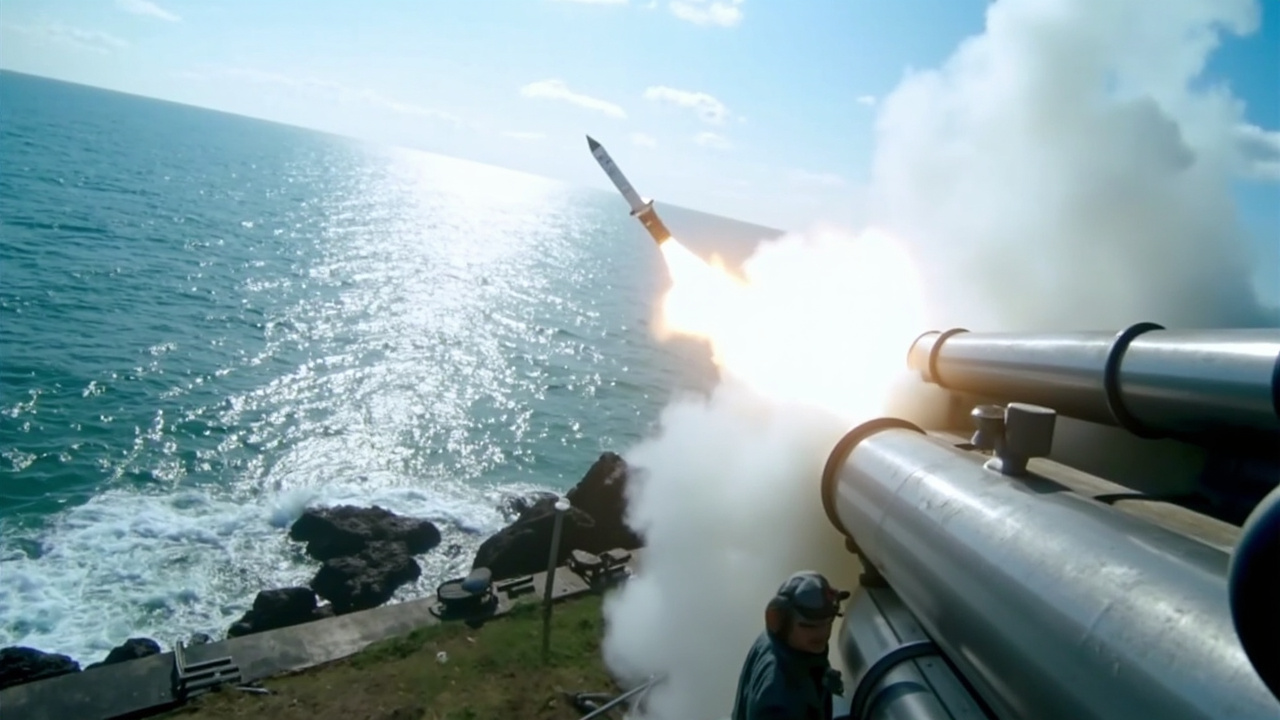
South Korea conducted its first test launch of a domestically developed hypersonic glide vehicle, or HGV, on Thursday, Oct. 8, 2026, according to the Associated Press.
The presidential office said the vehicle separated from its booster rocket at the planned altitude, dropped to a lower altitude and then adjusted its course both vertically and horizontally before accurately striking a designated test target, according to Yonhap News Agency.
Presidential spokesperson Kang Yu-jung said in a written briefing that the vehicle “successfully separated from its booster and seamlessly executed its planned flight path under hypersonic conditions,” according to Yonhap News Agency.
The announcement did not disclose the launch location, according to the Associated Press. Yonhap News Agency reported that the test reportedly took place from a barge at a test center operated by the Agency for Defense Development in Taean, about 130 kilometers south of Seoul.
President Lee Jae Myung watched the launch in person, accompanied by Defense Minister Kang Shin-chul and other officials, according to Yonhap News Agency. Lee described the event as a major step for conventional defense capabilities, according to the Associated Press.
What the weapon is designed to do
An HGV uses a booster to accelerate and climb into the upper atmosphere before separating from the booster and gliding at lower altitudes at hypersonic speeds, according to Yonhap News Agency.
South Korean officials described the system as designed to fly at least five times the speed of sound and to evade missile defense systems, according to the Associated Press. France24, citing Agence France-Presse, reported the same threshold of five times the speed of sound or greater for hypersonic glide vehicles.
The presidential office called the future weapon a game-changing strategic asset capable of surprise precision strikes against enemy targets, according to Yonhap News Agency. It said that once developed, the weapon would be able to strike key targets by surprise in the “Korean Peninsula theater of operations,” according to the Associated Press.
Spokesperson Kang said preparations were complete to secure a new deterrent capable of striking critical targets across the theater of the Korean Peninsula, according to Yonhap News Agency.
France24 reported that Seoul described the system as a “key strategic asset capable of changing the course of the battlefield,” with unpredictable flight paths and overwhelming speed intended to hit key strategic targets.
Technologies verified in Thursday’s flight
The Oct. 8 launch was carried out to verify core hypersonic technologies, including flight trajectories and speed, according to Yonhap News Agency.
The test was aimed at checking super-high-temperature thermal protection materials, guidance and control systems, and irregular maneuverability at low altitudes, Kang said, according to Yonhap News Agency.
France24 reported that the test sought to verify ultra-high-temperature heat-resistant materials, guidance and control capabilities, and the ability to fly irregularly at low altitudes under hypersonic flight conditions.
Unlike traditional ballistic missiles, the HGV descended after separation and performed horizontal and vertical course adjustments before hitting the target, according to Yonhap News Agency.
Hong Sung-pyo, a senior researcher at the Seoul-based Korea Institute for Military Affairs, told Agence France-Presse that South Korea had devoted considerable effort to the technology and could be said to have achieved a successful test, according to France24.
Lee links test to self-reliant security
After observing the launch, Lee commended the development team for advancing national defense capabilities and stressed that national security should be protected through its own strength, according to Yonhap News Agency.
Lee stressed that South Korea “must secure our security through our own strength,” according to the Associated Press.
“The government will fully support the development and operational deployment of advanced weaponry so that our people can live without concern,” Lee was quoted as saying by Kang, according to Yonhap News Agency.
Lee added that the team must not rest on the success but further refine the technology so the HGV becomes a reliable strategic asset, according to Yonhap News Agency.
Lee has called for strengthening conventional defense capabilities while reducing reliance on the United States, which unilaterally decided to scale back a major military exercise with the South in August, with President Donald Trump citing his “very good relationship” with Kim Jong Un, according to the Associated Press.
Hyunmoo-5 inspection follows HGV observation
Following the HGV observation, Lee inspected the military’s Hyunmoo-5 surface-to-surface missile, according to Yonhap News Agency.
The Hyunmoo-5 is described as a “bunker buster” and nicknamed the “monster missile” for its heavy weight and destructive power, according to Yonhap News Agency. Lee also inspected the country’s most powerful Hyunmoo-5 ballistic missile on Thursday, according to the Associated Press.
It was the first time the government officially used the name “Hyunmoo-5” in a press statement, according to Yonhap News Agency. The system had previously been a covert project referred to only as a “high-power missile,” according to Yonhap News Agency.
His office did not mention any direct comments by Lee on North Korea during the events, according to the Associated Press.
Test follows border mine blasts and missile exchanges
Tensions between the Koreas increased in recent weeks after South Korean soldiers were injured in land mine explosions last month near the heavily armed inter-Korean border, according to the Associated Press.
Yonhap News Agency reported that Thursday’s unannounced launch was widely seen as a countermeasure to a Sept. 21 land mine explosion on the South’s side of the Military Demarcation Line that severely injured two South Korean soldiers. Seoul determined the blast was caused by mines planted by North Korean troops in violation of the armistice agreement, according to Yonhap News Agency.
The South’s military and the U.S.-led United Nations Command concluded the blasts were caused by devices planted by North Korea, which has denied responsibility and ridiculed the South’s demands for an apology, according to the Associated Press.
Defense Minister Kang Shin-chul has said “various countermeasures” were under consideration after the military detonated the blast site during a mine-clearing operation Monday as part of its initial response, according to Yonhap News Agency.
The government of Lee, who favors rapprochement toward Pyongyang, has faced criticism for taking a passive stance after the mine blast, according to Yonhap News Agency. Critics accused Lee and officials of acting too cautiously so as not to upset the North, according to Yonhap News Agency. The tensions have been a setback for Lee, who favors engagement and has tempered rhetoric even as public anger grew, according to the Associated Press.
North Korea’s Oct. 3 launch provides immediate backdrop
There was no immediate response from North Korea to the South’s test, according to the Associated Press. North Korea last week tested its own hypersonic missile that landed in waters near Japan, according to the Associated Press.
North Korea test-fired Saturday what was assessed to be a hypersonic medium-range ballistic missile, with leader Kim Jong Un in attendance, according to Yonhap News Agency. In its Oct. 3 test, North Korea launched what it described as a hypersonic intermediate-range missile that it said flew more than 1,000 kilometers, or 621 miles, according to the Associated Press.
South Korea said it detected the missile flying more than 700 kilometers, or 435 miles, while Japan’s Defense Ministry assessed that it flew about 680 kilometers, or 422 miles, according to the Associated Press. Japan said the missile landed in waters outside its exclusive economic zone, according to the Associated Press.
Kim Yo Jong, the sister of the North Korean leader, claimed the differing flight estimates showed the allies were incapable of properly tracking the missile and therefore unable to intercept it, according to the Associated Press.
Pyongyang said its Saturday launch involved the use of artificial intelligence and claimed there was “no way to avoid” a missile capable of changing its flight orbit at low altitude, according to France24. It also said a “wave-like trajectory mode” left South Korea and Japan unable to track it effectively, according to France24.
Both Seoul and Washington said the missile could be “sufficiently detected and intercepted using the defensive assets possessed by the two allies,” according to France24.
North Korea has stepped up weapons testing as Kim expands the military nuclear program while taking a harder line toward Seoul, according to the Associated Press. Analysts say North Korea has stepped up testing of hypersonic weapons with technological support from Russia, according to France24. Moscow has used hypersonic missiles in combat since around 2024, according to analysts cited by France24.
Kim has rebuffed Trump’s calls to revive diplomacy that broke down in 2019, with Pyongyang demanding that Washington abandon its “hostile” policy and drop demands for denuclearization as a precondition for talks, according to the Associated Press.
Sources referenced
- South Korea test-flies its first domestically developed hypersonic weapon - ABC News (https://abcnews.com/International/wireStory/south-korea-test-flies-domestically-developed-hypersonic-weapon-137090542)
- (2nd LD) S. Korea conducts 1st test launch of hypersonic glide vehicle amid N.K. tensions | Yonhap News Agency (https://en.yna.co.kr/view/AEN20261008008652315?section=national%2Fpolitics)