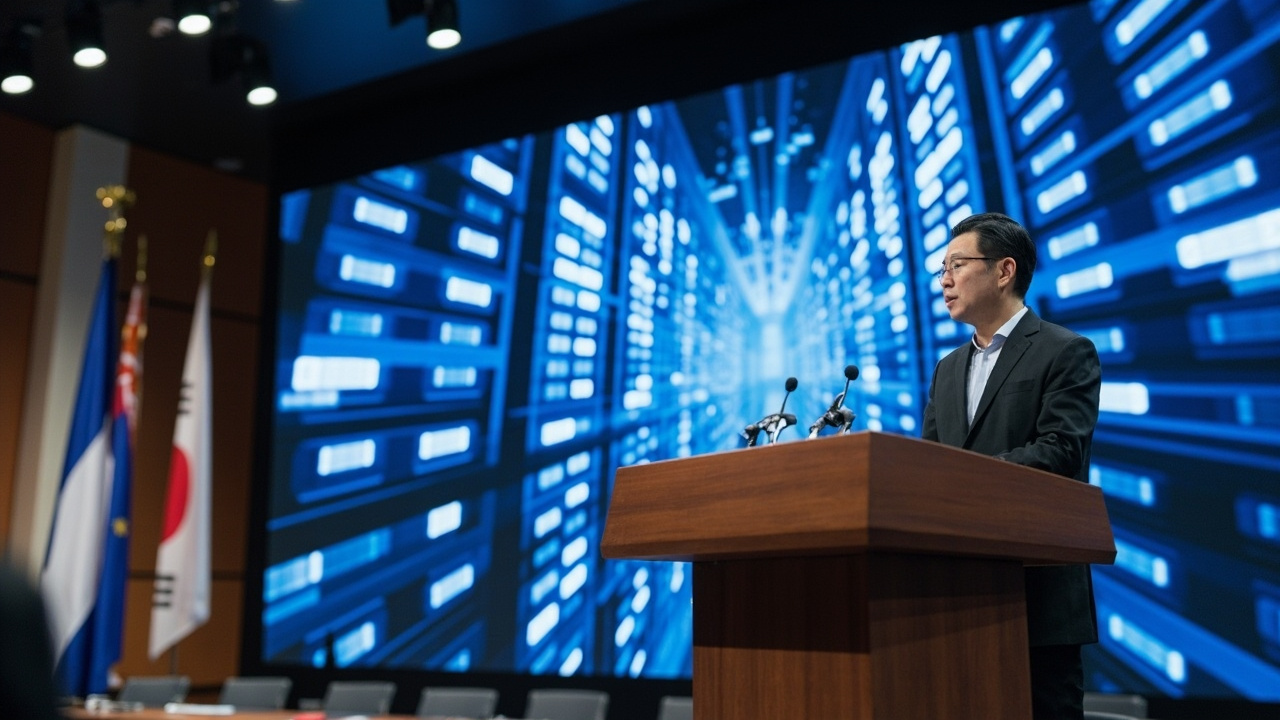
TL;DR: South Korea announced a proposed 4.7 trillion won ($3.5 billion) frontier AI program to start next year, pending parliament approval of the 2027 budget, while keeping its existing sovereign-model competition running on a separate track.
South Korea will pursue a state-backed frontier artificial intelligence model under a 4.7 trillion won equity-investment proposal, with development potentially beginning as early as next February or March after lawmakers act on the 2027 budget in December, according to Reuters.
The Ministry of Science and ICT described the effort on Oct. 2 as a new, larger-scale track alongside — not a replacement for — the country's ongoing national AI foundation model project, according to The Korea Herald and The Korea Times. Second Vice Minister of Science and ICT Ryu Je-myung told reporters in Seoul that technology development would move toward frontier models while industrial use of Korean models would proceed on a separate deployment track.
The announcement marks a two-track redesign of national AI policy. One track aims for a top-tier homegrown model competitive with leading Chinese open-source systems. The other supports industry-specific and real-world applications of Korean-developed models without requiring frontier-scale computing, according to The Korea Herald.
What was announced and when it could start
The 2027 budget proposal earmarks 4.7 trillion won in government equity investment for the frontier program, with private capital expected to supplement public funds, according to The Korea Herald. Reuters reported that the Ministry of Science and ICT plans to select a lead developer through a competitive tender after parliament approves the 2027 budget in December.
The Korea Herald reported that officials are weighing a program start as early as March, once budget approval is secured. The Korea JoongAng Daily reported that applications for the new program could open as soon as the budget is finalized at the end of the year, with development possibly beginning as early as February when final teams for the sovereign AI project are decided.
The ministry plans to unveil an outline of application criteria later this month, according to The Korea Times. Participation would be open beyond the current finalists, including startups with strong technology and talent, according to The Korea Herald.
How the 4.7 trillion won would be used
Government planners expect the investment to include 3.9 trillion won to provide 10,000 Nvidia Vera Rubin graphics processing units and 800 billion won to purchase training data, according to The Korea Times.
Participating companies would be required to match the government investment with corresponding private-sector funding, according to The Korea Times. The Korea Herald reported the same structure in broader terms, saying private capital was expected to supplement the proposed public investment.
Rather than providing grants or subsidies alone, the government has earmarked the funds for equity investment, according to The Korea Times. Officials said that approach would allow returns to ultimately be shared with the public. Setting up a special purpose company has emerged as one option for carrying out the investment, although details on structure, anchor companies and startup participation have yet to be finalized, according to The Korea Times.
The Korea Herald reported that the investment structure remains undecided, with options including a consortium or a special-purpose company. The ministry is reviewing roles for major companies, startups and other investors, according to that report.
Why officials say a bigger push is needed
Ryu said government officials and domestic companies shared the view that global competition for advanced models entered a different phase after the preview of Claude Mythos emerged in April, according to The Korea Times. With rivals competing at enormous scale, officials said the moment called for pooling resources rather than continuing only with a competition-based approach and smaller-scale support.
“The frontier AI project will begin next year,” Ryu said, according to The Korea Times. “It will be reflected in next year's budget, and we will pursue a higher goal by breaking through current technological limitations.”
Ryu said the choice was whether to target a mid-tier model or one capable of competing with leading global models, and whether to give companies more graphics processors to compete individually or concentrate resources to close the gap with frontier systems, according to The Korea Times. He said companies in the national foundation-model project told the ministry that competing at the frontier level would require an approach like the frontier AI project.
The Korea Herald quoted Ryu as saying investment at the level of 1,000 graphics processing units was insufficient to catch up with frontier-class models. “The scale has to be completely different,” he said, according to that report.
Ryu also said competing head-on with the largest U.S. AI companies would be unrealistic, but South Korea could aim for a model competitive with leading Chinese open models if the planned public and private investment materializes, according to The Korea Herald.
What happens to the existing sovereign-model contest
The national foundation model project, known in Korean as Dokpamo, was launched in 2025 to develop South Korea’s most capable homegrown models through survival-type competition, according to The Korea Times and The Korea Herald. Three teams — those led by LG AI Research, SK Telecom and Upstage — are now in the third stage, after which two finalists will be selected, according to those reports.
The Korea Times reported that the two finalists are to be selected by the end of this year. The Korea Herald reported that the current competition’s third stage runs through January, with results expected around mid-February. The ministry has said the competition will proceed as planned, while its focus shifts toward industry-specific applications.
Under the original plan, each of the final two participants was to receive 1,000 graphics processing units throughout 2027, according to The Korea Times. Ryu said that computing commitment would remain, but the two finalists could choose either to join the frontier AI project or focus on expanding their national foundation models for industry-specific applications.
The ministry said the frontier project is not a replacement for the national foundation-model effort but a new initiative aimed at national security needs and other major challenges, according to The Korea Times. It said it would link the two projects so technologies, talent and the ecosystem developed through the national project could support the frontier effort.
Ryu rejected suggestions that the government was abandoning its independent foundation-model program, according to The Korea Herald. “The goal of securing our own foundation model technology has not changed, and it will not be discontinued,” he said. “It will continue.”
He added that the government would select two finalists from the current contest, according to The Korea Herald. “We will select two. That is certain,” he said.
Ryu acknowledged criticism of the elimination format. “The competition created a stigma for companies that were eliminated and stirred public controversy,” he said, according to The Korea Times. He said officials recognized that risk from the beginning but viewed intense competition as unavoidable amid resource constraints.
The Korea Herald reported that the ministry is considering incentives for the finalists to recognize resources already committed, but Ryu said those measures should not distort allocation of public funding. “Participation should be open,” he said, adding that startups should have fair opportunities to compete.
Parliament hearing adds cybersecurity and deployment details
Deputy Prime Minister and Minister of Science and ICT Bae Kyung-hoon told a parliamentary audit of his ministry on Oct. 6 that South Korea would press ahead with the sovereign AI foundation-model project while adding the separate frontier program to counter cybersecurity threats, according to Aju Press. Bae also serves as science minister.
Bae said the sovereign project had cleared its second evaluation and was entering a third round, according to Aju Press. He said the results so far were midrange by global standards and described the third phase as aiming for a model close to leading open-weight systems used worldwide.
Through the second evaluation, South Korea was cementing its standing as a leading AI nation, Bae said, according to Aju Press. He also said the bar had risen sharply since last year as the U.S. government’s superintelligence push set targets beyond earlier goals.
Bae linked the 4.7 trillion won frontier program to the “Mythos shock,” a reference to Anthropic’s Claude Mythos model, according to Aju Press. “The sovereign model will stay on target, but we judged that a frontier AI project is additionally needed to tackle humanity's unsolved problems and respond to cybersecurity threats,” he said. He added that current sovereign models would struggle to reach the level sought by industry and the public sector.
In opening remarks at the same hearing, Bae named AI data centers, physical AI and semiconductors as three “mega projects,” according to Aju Press. He also said an “AI for All” service, free and with no usage caps, will launch by the end of the year.
Computing supply and next decisions
The ministry is also preparing to allocate about 29,000 graphics processing units the government has purchased or is bringing online, according to The Korea Herald. A distribution plan is expected by year-end.
The next formal step is parliament’s review of the 2027 budget proposal, expected to conclude in December, according to The Korea Herald and Reuters. After approval, officials plan to open the frontier competition, evaluate applicants and choose participants for the equity-backed development effort.
For consumers and businesses, the near-term practical track is industrial deployment: Korean-developed models adapted for specific sectors and everyday services, alongside the longer-term frontier attempt. The government has not announced final participants, corporate roles or the legal form of the investment vehicle, leaving those decisions for after the budget and application rules are set.
Sources referenced
- South Korea plans to develop $3.5 billion frontier AI model starting next year | Reuters (https://www.reuters.com/world/asia-pacific/south-korea-plans-develop-35-billion-frontier-ai-model-starting-next-year-2026-10-06/)
- Korea to launch $3.5 bil. frontier AI project next year - The Korea Times (https://www.koreatimes.co.kr/business/tech-science/20261005/korea-to-launch-35-bil-frontier-ai-project-next-year)