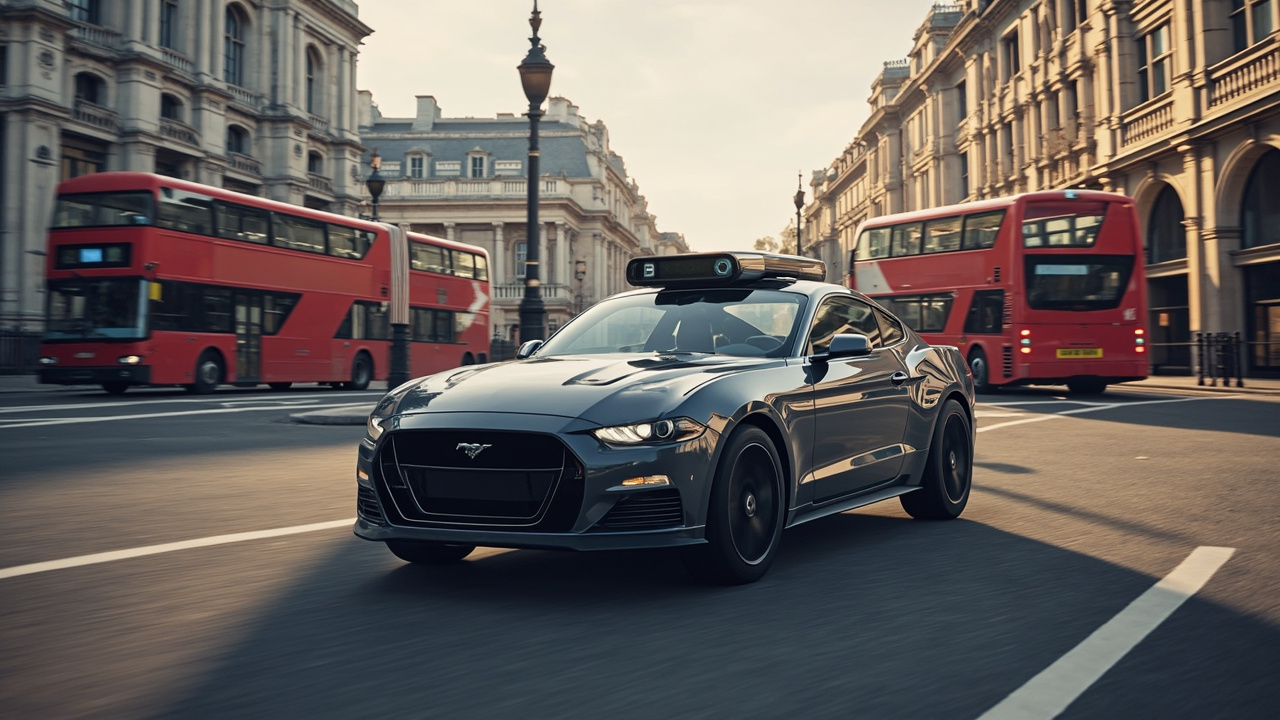
TL;DR: Uber and Wayve launched supervised autonomous rides in London on September 3, 2026, letting UberX, Uber Comfort and Uber Electric riders match with a self-driving Ford Mustang Mach-E at no extra cost.
London gets its first bookable robotaxis
Uber Technologies Inc. and British artificial intelligence company Wayve launched supervised autonomous rides in London on Thursday, September 3, 2026, according to Wayve's official announcement titled "Wayve and Uber Launch First-Ever Autonomous Rides in the UK."
The debut marks the first time autonomous trips have been available to the public in the United Kingdom through a ride-hailing app, according to that announcement. Starting that day, Londoners requesting an UberX, Uber Electric or Uber Comfort trip could be matched with a Wayve-powered ride at no extra cost, with upfront fares shown in the app.
Reuters, in its report titled "Uber and AI-firm Wayve launch London's first robotaxis," described the event as London's first robotaxi launch and said London became the second city in Europe after Zagreb where Uber offers robotaxis.
The service began as supervised autonomy, not driverless operation. A trained and Transport for London-licensed private hire driver rides on board to oversee each trip, according to Wayve. Reuters similarly reported that initially a licensed operator will be on board.
How riders get a Wayve car
Matching is optional and familiar for regular Uber users. Riders can boost their chances of receiving a Wayve vehicle by opting in through Trip Preferences under Settings in the Uber app, according to Wayve.
More than 140,000 Londoners had already opted in before launch day, Wayve said. On every trip where a Wayve car is assigned, riders have the option to accept the autonomous ride or switch to a non-automated ride before the car arrives.
Once the vehicle arrives, riders unlock the doors and start the trip from the Uber app. The in-vehicle experience, designed by Uber, includes an interactive screen available in 64 languages where riders can start their trip and view the vehicle's planned path, according to Wayve.
Upfront pricing remains visible in-app before booking, and Wayve said there is no extra charge for being matched with an autonomous vehicle on the eligible Uber products.
Where the cars go and how many there are
At launch, riders can travel anywhere within London apart from airports, according to Wayve. The company framed that coverage as unusually broad because there is no geofence limiting operation to a small mapped zone.
The Verge, in its report titled "Uber beats Waymo to launching robotaxis in London," said Wayve expects to offer service across London not including airports, citing Wayve spokesperson Julianne McGoldrick. The same report said the system is designed to move beyond the constraints of traditional automated systems.
The fleet is small at the start. CBS News, in its report titled "Uber robotaxis hit London's streets, but with humans still behind the wheel," said Uber rolled out 15 autonomous Ford Mustang Mach-E vehicles in London. The Verge reported that Wayve has around 15 vehicles registered with Transport for London, which may make it difficult to be matched with one initially.
Wayve said it is starting with a small number of vehicles and will grow thoughtfully over time in line with rider demand, readiness and regulation. Reuters also characterized the rollout as beginning on a limited basis.
Safety driver still behind the wheel
Any automated vehicle on the Uber network must meet the company's Safety Guidelines, according to Wayve. For this initial phase, supervision remains in the front seat.
The on-board supervisor is a trained and Transport for London-licensed private hire driver, according to Wayve. The Verge reported that safety drivers will monitor driving from the front seat, will not control driving under normal operation, and will gradually be phased out in favor of fully driverless vehicles as permissions allow.
Under the United Kingdom government's pilot framework, operators still need approval to operate without a human safety driver, according to reporting carried by The Independent in its article titled "Robotaxi service debuts on London's busy streets as Europe weighs more self-driving vehicles." In that report, Sarfraz Maredia, Uber's head of autonomous mobility, said that process was still playing out and that it was not clear how long it would take.
CBS News reported that London regulators still do not allow full autonomy on the roads yet, which is why a supervisor must be on board. That distinction is central for consumers: the car drives itself under supervision, but it is not yet a rider-only driverless taxi.
Inside the Wayve AI Driver
Riders matched with the service travel in an all-electric Ford Mustang Mach-E equipped with the Wayve AI Driver and surround sensors, according to Wayve. The vehicles use cameras and radar as part of their perception system and notably do not use lidar, according to The Verge.
Wayve describes its approach as AV2.0, an AI Driver that learns from experience in a manner comparable to human learning, allowing it to scale and adapt without relying on traditional high-definition maps or hand-coded rules, according to the company's launch announcement. Headquartered and founded in London, Wayve said it has built and specifically trained the technology on the capital's roads since 2018.
Wayve said its autonomous driving technology is agnostic to vehicle platforms and sensor configurations, a design intended to help it scale quickly. The Verge reported that while additional sensors such as lidar could theoretically be integrated if a manufacturer prefers them, the AV2.0 system is built to operate without high-definition maps or expensive sensors.
CBS News reported that Wayve Chief Executive Alex Kendall said the company trains its system on millions of hours of driving experience from around the world, so it can interpret unfamiliar scenes and make decisions in real time rather than requiring prior detailed mapping of every street. Kendall also said Wayve has driven in more than 500 cities in Europe, Asia and North America.
Why London is a difficult test
London presents narrow streets, frequent congestion, buses, bicycles, electric rental bikes and complex interactions. The Independent noted that robotaxi companies have been testing on London streets as Britain moves toward national regulations, and that the city's narrow and convoluted roads pose unique challenges.
CBS News quoted Kendall describing roads that are hundreds of years old, many roundabouts and interaction scenarios, more than 10 times more cyclists and pedestrians than in cities like San Francisco, and more than 10 times the amount of roadwork. He described London as constantly busy and evolving.
That complexity is part of why Wayve chose its home city for the public debut. Alex Kendall said the company was proud to introduce the Wayve AI Driver to the public for the first time in London, describing it as one of the most complex driving environments in the world and saying autonomous driving will complement the city's transport network.
Sarfraz Maredia, Global Head of Autonomous Mobility at Uber, said London is a world-class hub for transportation innovation and called the launch a major milestone in scaling safe, accessible automated vehicle technology in a city with complex roads, according to Wayve.
An early media ride illustrated the limits. CBS News reported that a CBS crew called a Wayve robotaxi and that the vehicle operated autonomously at first, but when it tried to go through a narrow passageway it became stuck and the supervisor had to take over and drive.
Government reaction and commercial plan
British officials welcomed the launch as a showcase for domestic artificial intelligence. Transport Secretary Heidi Alexander said it was a major milestone for the future of transport in London, that British innovation brings the technology onto roads and gives passengers more choice, and that the government wants to support investment and skills while recognizing the role of current sector workers, according to Wayve.
Business Secretary Jonathan Reynolds said people would be able to step into the technology of the future as autonomous vehicles are rolled out in London, calling it a hugely exciting milestone and pointing to homegrown British AI from Wayve, according to Wayve.
Commercially, the London debut is part of a broader Uber and Wayve partnership that included an investment to put Wayve-powered vehicles on the Uber network in 12 markets around the world, beginning with London, according to Wayve. The companies also plan to introduce the Nissan LEAF vehicle powered by the Wayve AI Driver using NVIDIA DRIVE Hyperion, starting in Tokyo later this year.
Wayve said maintenance and servicing details involve Uber working with fleet operator Otto Car, while Wayve remains in charge of the autonomous driving system, according to The Verge. The Verge also reported that Uber has said it plans to spend upwards of $10 billion over time to build its robotaxi business and works with multiple automated-driving partners including Zoox, Avride, Nuro, Motional, Waabi and Wayve.
Competition is already forming. The Verge reported that Waymo has said it will launch robotaxis in London before the end of the year and that Lyft is working with China's Baidu on a service starting in the neighborhood of Brent. CBS News reported that Waymo, a subsidiary of Alphabet, has been mapping London but had not rolled out vehicles for public use by launch week, and that Wayve's investors alongside Uber include Nvidia and Microsoft.
For black-cab drivers, short-term displacement was downplayed. CBS News reported that London's black-cab numbers fell from about 25,000 in 2010 to approximately 16,000 today, citing Transport for London statistics, and quoted Maredia saying Uber does not see robotaxis as a near-term risk to those drivers because the market is growing.
Sources referenced
- Wayve and Uber Launch First-Ever Autonomous Rides in the UK - Wayve (https://wayve.ai/press/wayve-uber-launch-autonomous-rides/)
- Uber and AI-firm Wayve launch London's first robotaxis - Reuters (https://www.reuters.com/business/uber-ai-firm-wayve-launch-londons-first-robotaxis-2026-09-02/)