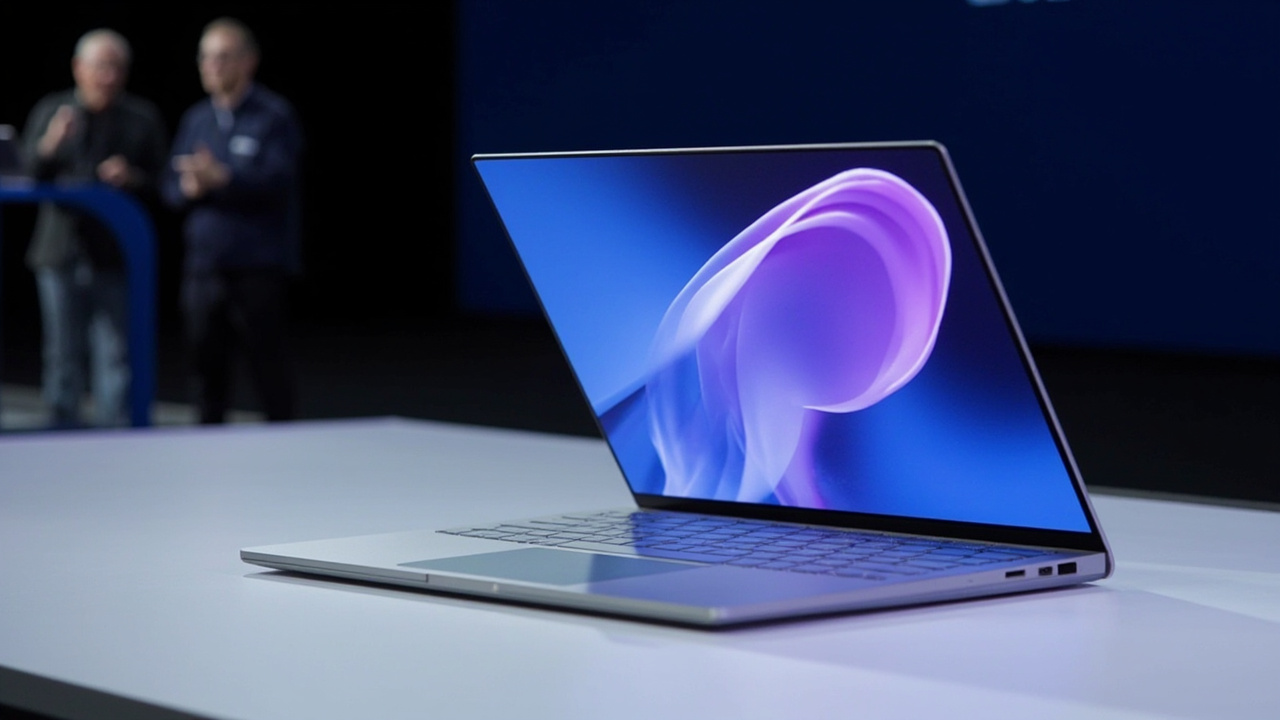
TL;DR: Microsoft opened preorders on October 7, 2026 for the NVIDIA RTX Spark-powered Surface Laptop Ultra starting at $2,599, positioning Windows PCs for on-device AI agents.
Microsoft used a Windows and Surface event in San Francisco on Wednesday to open a new push for local AI on Windows PCs, with laptop preorders starting that day and availability set for Friday, Oct. 16. According to the NVIDIA Blog, NVIDIA founder and CEO Jensen Huang joined Microsoft CEO Satya Nadella at the event to outline co-engineered hardware and software for AI agents to run on Windows PCs.
The gathering was staged at Dogpatch Studios in San Francisco and hosted as a fireside chat by Sriram Krishnan, a former senior White House policy advisor on AI, according to the NVIDIA Blog. The program opened with Nadella, followed by Pavan Davuluri, executive vice president of Windows and Devices at Microsoft, who walked through Windows updates for what Microsoft calls the agentic era.
What Microsoft opened for preorder
The centerpiece for consumers, developers and creators was Surface Laptop Ultra, described by Microsoft as its most powerful Surface laptop yet. According to Engadget, which published updated event coverage on Oct. 7, 2026, the machine runs on NVIDIA's RTX Spark system-on-a-chip and pre-orders started that day for availability on October 16.
According to The Verge, the Surface Laptop Ultra will start at $2,599 for a configuration with an 8-core CPU, 24GB of RAM, and 512GB of storage, with release on October 16th. The publication also reported that the Surface RTX Spark Dev Box, a mini PC for developers, is available for preorder for $5,999 ahead of shipping in November.
That pricing structure places the new category well above the sub-$2,000 pricing Microsoft emphasized when it originally pitched running AI tasks on PCs two years ago. According to Reuters, the new Surface Laptop Ultra will start at $2,599 and rise to $5,899 for a model with a 20-core processor, 128 gigabytes of memory and one terabyte of storage.
RTX Spark hardware inside the laptop
Microsoft built Surface Laptop Ultra around NVIDIA RTX Spark, a superchip that combines an NVIDIA Blackwell RTX GPU with an NVIDIA Grace CPU and large unified memory. According to the NVIDIA Blog, RTX Spark combines an NVIDIA Blackwell RTX GPU with up to 6,144 cores, and an up to 20-core NVIDIA Grace CPU connected at 600 GB/s.
The same report puts performance at one petaflop of FP4 AI performance and up to 128GB unified memory for local AI. According to the Microsoft Devices Blog, which published preorder details on October 7, 2026, the laptop can run AI models exceeding 120B parameters locally, with up to 1 petaflop of AI performance.
Pavan Davuluri tied the hardware choice directly to model size, saying the company built Surface Laptop Ultra around NVIDIA RTX Spark, according to the NVIDIA Blog. Davuluri said the laptop offers up to 128 gigs of unified memory and up to a petaflop of AI compute, adding that users can run models on the laptop that simply do not fit on a traditional machine.
The platform is not limited to Microsoft hardware. According to the NVIDIA Blog, systems are coming from Acer, ASUS, Dell, HP, Lenovo, Microsoft, MSI and Gigabyte with designs ranging from slim laptops to compact desktops built for always-on agents. Laptop preorders opened on the day of the event, while compact desktops will be available for sale in November.
For developers, RTX Spark runs the full NVIDIA CUDA platform, the same software stack that runs across NVIDIA hardware, according to the NVIDIA Blog. That design is intended to let developers move models, tools and workflows without rewriting, running the same NVIDIA AI stack from RTX Spark to DGX Station.
How Surface Laptop Ultra is built
Beyond the chip, Microsoft emphasized thermals, display, size and connectivity. According to Engadget, the device has a 15-inch mini-LED display with up to 2,000 nits of brightness and a 3:2 aspect ratio. The report also says the trackpad is 30 percent larger than the one on the seventh-generation Surface laptop.
Weight and thickness were presented as portability points for a high-performance system. According to Engadget, the laptop weighs less than 4.5 pounds and is less than 18mm thick. Microsoft claims it has 2.5 times the thermal capacity of the seventh-generation 15-inch Surface Laptop and all-day battery life.
According to the Microsoft Devices Blog, the company designed a new thermal architecture that delivers up to 2.5x more thermal power capacity than current Surface Laptops, in a chassis less than 18 mm thin and under 4.5 lb. That post describes the 15-inch PixelSense Ultra touchscreen as the brightest, sharpest and most vivid display Microsoft has put on a Surface Laptop.
Connectivity was another focus. According to Engadget, the laptop is positioned as a MacBook Pro competitor, with more ports, including USB-A, USB-C, HDMI, a 3.5mm headphone jack and a full-size SD card reader. A magnetic charging option that uses a regular USB-C port is available.
The Microsoft Devices Blog identifies that feature as Magnetic Connect, described as the world's first built-in magnetic USB-C charging on a laptop. According to that post, the included charging cable attaches magnetically to the right-side USB-C port and releases easily, while the port remains fully functional for video, data and other USB-C devices. Other ports listed are two additional USB-C ports, HDMI, USB-A, an SD card reader and a 3.5 mm headphone jack, with support to drive up to three 4K displays.
The same Microsoft post says storage is user-removable, so users can upgrade, replace or secure their own storage. It lists colors as Platinum and Nightfall.
Windows changes for AI agents
Microsoft framed the hardware launch as part of a broader effort to make Windows a secure platform for agents. According to the NVIDIA Blog, Microsoft announced general availability of Microsoft Execution Containers, the OS-level infrastructure that lets agents run safely and persistently in the background, under operating system control.
Davuluri said the company is building those primitives directly into Windows so agents can be secured, observed and governed, according to the NVIDIA Blog. He added that with Microsoft Execution Containers, Microsoft Security and Agent 365, the company is unlocking the full potential of agents on Windows.
Nadella returned to the security theme in his talk with Huang, saying the company needed to make the desktop the most secure place for agents to execute, according to the NVIDIA Blog. Huang said Microsoft's new execution container technology, known as MXC, is going to revolutionize how agents are built and deployed.
According to Reuters, Microsoft said it was releasing Microsoft Execution Containers as a tool to prevent agents from accessing data and doing unauthorized tasks when running on a laptop or desktop machine. That report says Anthropic, OpenAI and Nvidia will use the tools, citing Davuluri, and that new tools would let IT departments set rules for agents with enforcement by Windows on each employee's machine.
On the assistant side, Microsoft described a hybrid approach that splits work between local models and the cloud. According to Engadget, Copilot will be able to carry out actions based on local files with permission, run AI models locally while tapping into the cloud for extra compute power, and generate apps and widgets.
Reuters quoted a similar description of the split, attributing to Microsoft Copilot chief Jacob Andreou the statement that Copilot will still use the cloud for the hardest tasks, but for times when cost or privacy matter more, it can delegate down to local models that run directly on the computer.
Microsoft also updated Windows search and onboarding for agents. According to Engadget, starting this fall, users will be able to take thousands of quick actions directly in Windows search from the taskbar, including switching on dark mode, taking a screenshot, adjusting the volume, getting answers to questions and sending text messages. The same report says Microsoft is looking to make it easier to get AI agents running in Windows with a Get Started tool.
Third-party agents were part of the announcement. According to Engadget, the Perplexity Portable Computer agent will be able to run locally, while Muse will be available as a native Windows app. According to Reuters, Davuluri said Meta's Muse personal assistant will come to Windows devices as a native app, using some of Microsoft's new security tools, and that OpenClaw, the open-source AI agent system, can also work with those security tools.
Local models, creators and gaming
Microsoft said high-memory Windows machines can now run models that previously required cloud access. According to the NVIDIA Blog, RTX Spark can run models such as Qwen 3.8 Flash Next, described as a 125B model with 51B n-gram that matches the intelligence of many cloud models, unmetered and without sending data to the cloud.
According to Reuters, Davuluri said a version of Chinese AI firm DeepSeek's V4 model can run on machines with at least 60 gigabytes of memory and outperform OpenAI's GPT-5 on some coding and reasoning tasks. The same report says Microsoft also unveiled AI models that previously required cloud access but can now run locally, including Nvidia's open-source Nemotron model.
For creative work, the NVIDIA Blog lists 5th-generation Tensor Cores with NVFP4 support, hardware-accelerated AV1, and 4:2:2 video encode and decode, plus DLSS and RTX ray tracing across the production pipeline. For gaming, it says players can run AAA games at 1440p over 100 frames per second with DLSS 5, Reflex and G-SYNC.
Engadget reported similar gaming credentials, saying the RTX Spark has GPU capabilities comparable to the GeForce RTX 5070, with support for ray tracing, DLSS and NVIDIA Reflex. That report says Microsoft showed Gears of War: E-Day running on the Surface Laptop Ultra and said Call of Duty will be available on the system later this year.
Power use was also highlighted. According to Engadget, the RTX Spark is said to be less power-intensive than other AI-focused chips, as it will not draw more than 80W. The same report notes the chip includes a neural processing unit fast enough to meet Microsoft's Copilot+ requirements.
Enterprise deskside system preview
In addition to laptops and compact desktops, the event previewed NVIDIA DGX Station for Windows. According to the NVIDIA Blog, the event previewed NVIDIA DGX Station for Windows as the first deskside AI supercomputer to bring GB300 Grace Blackwell-class AI infrastructure directly into the Windows ecosystem.
Davuluri said the system unlocks the power to run frontier-class models locally, describing capabilities that once required renting a cluster and are now in a deskside supercomputer, according to the NVIDIA Blog. Until now, DGX Station ran on Linux, a split that required enterprise developers to maintain separate Linux and Windows environments for heavy AI work and productivity tools.
Price pressure and competition
Microsoft presented the machines as alternatives for buyers considering high-end Apple laptops, but pricing remains a barrier. According to Reuters, Apple's MacBook Pro with a 40-core graphics chip, 128 GB of memory and two TB of storage costs $6,700, although the machines are not directly comparable. The same report notes Microsoft's entry-level Ultra costs more than Apple's $1,999 base MacBook Pro, but comes with 24 GB of memory compared with 16 GB on Apple's entry-level model.
Memory costs were cited as a broader issue. According to Reuters, Nvidia increased the price of an AI desktop machine called the DGX Spark by about 75% since its launch to $6,950 amid rising memory costs. Analyst Anshel Sag of Moor Insights & Strategy told Reuters that two years ago the software was not ready but the hardware was, while now the software is ready and the hardware is too expensive to run it locally for many buyers.
Sources referenced
- NVIDIA, Microsoft Kick Off a New Beginning for Windows PCs With RTX Spark and AI Agents | NVIDIA Blog (https://blogs.nvidia.com/blog/local-ai-rtx-spark-microsoft-windows-event/)
- Everything announced at Microsoft's Windows and Surface event | Engadget (https://www.engadget.com/2280298/everything-announced-at-microsofts-windows-and-surface-event/)