TL;DR: A parallel translation setup runs a second code without rewriting a genome
TL;DR: Harvard researchers built a cell-free system that runs an engineered genetic code alongside the normal code by pairing altered ribosomes with altered tRNAs.
A team led by George M. Church reported on Aug. 26, 2026, a method that lets a second, designed genetic code operate in the same reaction as the standard code, according to the Nature paper Automated prototyping of genetic codes and reporting by Ars Technica in Researchers get two genetic codes to work at the same time.
The platform is called automated genetic tRNA expansion, or AGENTEX, according to Nature. It prototypes codes robotically in cell-free translation mixtures rather than in living organisms. The work was carried out by Felix Radford, Nayan Sapers, Hana M. Burgess, Lucy Ort, Bogdan Budnik and George M. Church, with affiliations listed as Harvard Medical School and the Wyss Institute for Biologically Inspired Engineering at Harvard University.
The central result is separation by molecular matching. Engineered ribosomes accept only engineered transfer RNAs, while normal ribosomes continue to use normal transfer RNAs, according to Ars Technica. The tests reported in Nature were done in cell-free systems, not in an intact living cell.
Why changing the code is normally so difficult
One shared dictionary for nearly all genes
The standard code uses 64 codons to specify 20 canonical amino acids across domains of life, according to Nature. With minor variations, effectively the same code is used by every living thing, which suggests it was already present in the last common ancestor, according to Ars Technica.
That shared use is the obstacle. Messenger RNA carries triplets of bases to the ribosome, transfer RNAs pair with those triplets, and each transfer RNA delivers the corresponding amino acid to the growing protein, according to Ars Technica. Enzymes called aminoacyl-tRNA synthetases attach the correct amino acid to each transfer RNA, a step often described as charging, according to Ars Technica.
A broad change therefore affects many proteins at once unless every affected gene is adjusted. Previous bacterial work added new amino acids and removed one normal amino acid from proteins, but one program required re-engineering every gene in a bacterial genome, according to Ars Technica.
The Harvard announcement places that history in years. After nine years of effort, the Church laboratory reported in 2013 that it had freed one codon in Escherichia coli for a user-chosen amino acid, according to the Wyss Institute announcement Researchers clear major obstacle in genetic engineering of proteins. It then took another 10 years to free a second codon, allowing proteins containing up to 22 different amino acids, according to the same Wyss Institute announcement.
The workaround: give the second system its own docking signal
CCA tails, CGA ribosomes and two Watson-Crick contacts
Every natural transfer RNA carries the sequence CCA at its tail end, according to the Wyss Institute announcement. Longstanding expectation held that a different tail sequence would mark the molecule as defective, preventing charging by enzymes and use by ribosomes, according to the same announcement.
The new work focused on the other side of that interaction. Two Watson-Crick interactions in the ribosomal large subunit recognize the 3-prime CCA end of transfer RNAs and prevent transfer RNAs with alternative 3-prime sequences from being accommodated during translation, according to Nature.
Because the contact points were known, the team could change both sides of the match. Ribosomes carrying G2251C and G2553C changes in the large subunit, called CGA ribosomes, specifically accommodate transfer RNAs with 3-prime CGA ends and do not accept natural transfer RNAs for translation, according to Nature. The engineered transfer RNAs are termed otRNAs, meaning non-CCA-3-prime transfer RNAs, according to Nature.
In principle, this produces two populations that do not cross-talk. One population uses normal ribosomes and normal transfer RNAs. The other uses engineered ribosomes and CGA-ended transfer RNAs, according to Ars Technica. The Nature paper states that the otRNAs specifically interact with the CGA ribosome while avoiding crosstalk with the natural translation system.
The surprise: charging enzymes tolerated the new tails
Most variants could still receive amino acids
The uncertain step was whether natural charging enzymes would work with an altered tail. That question had not previously been tested directly, so the group created its own assay that distinguished charged from uncharged molecules through differences in chemical reactivity, using cell-free translation, robotics, next-generation sequencing and analytical chemistry, according to Ars Technica.
The answer was broader than expected. The transfer-RNA 3-prime end showed substantial tolerance for mutation, allowing aminoacylation of most otRNAs by all E. coli aminoacyl-tRNA synthetases, according to Nature. Depending on the exact changes, most of the modified transfer RNAs could be charged, according to Ars Technica.
A screening tool developed for the project, called tSCAN, identified nonstandard tail sequences that worked best, including CGA, according to the Wyss Institute announcement. The first author, Felix Radford, said the CCA end was much more flexible than people had assumed, according to the same announcement.
The practical consequence is simplicity. Natural synthetases can aminoacylate the engineered transfer RNAs in a one-pot reaction, according to Nature. That removes a need to engineer a separate charging enzyme for every engineered transfer RNA in these tests.
How AGENTEX builds and tests a code
Robotic pools of tRNAs plus lysate containing engineered ribosomes
AGENTEX combines custom lysate-based translation systems with synthetic pools of transfer RNAs carrying engineered anticodons, according to Nature. Lysate is produced from crude cell extracts and retains translational machinery and enzymes for RNA and post-translational modifications, according to Nature.
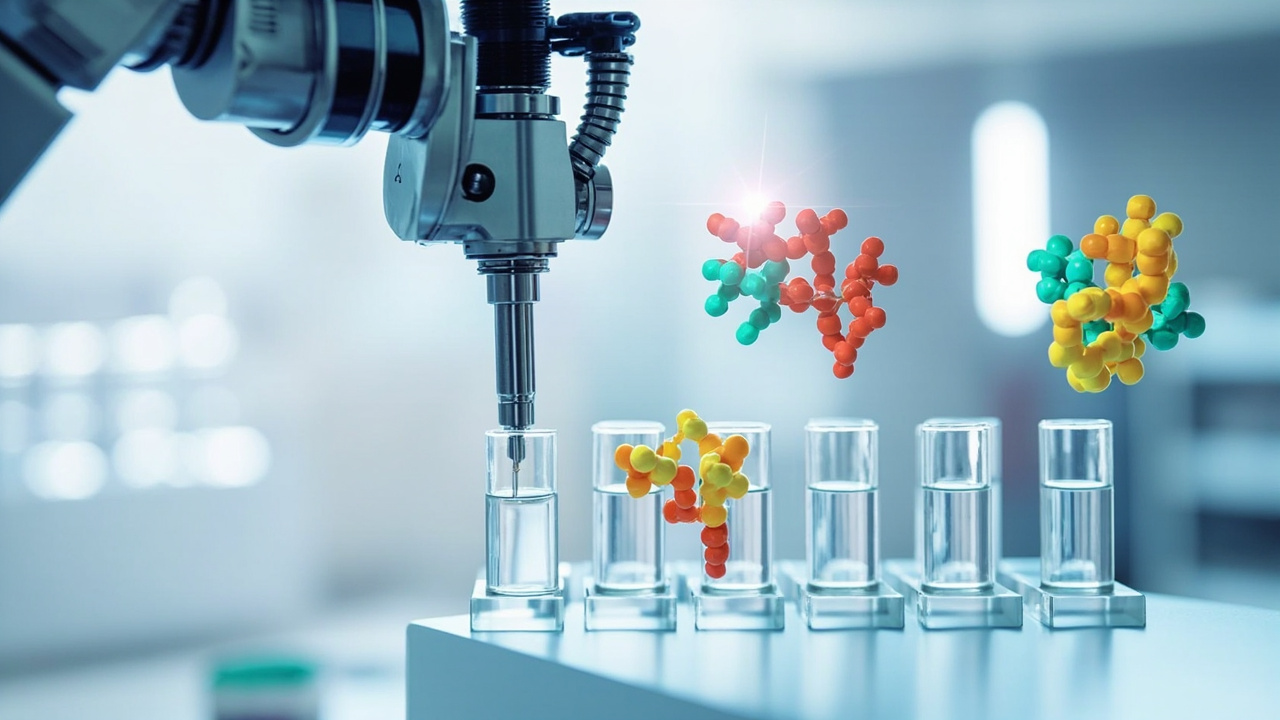
The workflow described in Nature starts with cells that contain CGA ribosomes. Those cells are lysed to produce a cell-free translation mixture. Each candidate genetic code is synthesized as a pool of otRNAs that are robotically produced and added to the lysate. Messenger-RNA templates are also synthesized and purified automatically, and subsequent reaction steps are automated, according to Nature.
During translation, the synthetases already present in the lysate continue to charge the otRNAs, according to Nature. The effect of each code, defined by the composition of its transfer-RNA pool, can then be measured and used to design the next round of code experiments, according to Nature.
Harvard’s announcement describes the same configuration in nontechnical terms: researchers engineer the two building blocks, transfer RNAs and ribosomes, and place them into a standard laboratory mixture that contains cell components but no intact cells, according to the Wyss Institute announcement. The components then produce the new proteins without interfering with the natural protein-making machinery, according to the same announcement.
Radford said AGENTEX lets researchers generate entirely new genetic codes on demand in test tubes and use them at larger scale to build proteins beyond what nature has evolved, according to the Wyss Institute announcement. He added that the approach was more rapid and safe than existing methods because it did not rely on handling living cells or altering their genomes, according to the same announcement.
What the team demonstrated: compressed codes and reassigned codons
34 codons, two test codes and up to three changed codons
The Nature study reports cell-free systems supporting compressed genetic codes using 34 synthetases for 34 codons, according to Nature. In the compressed design, 20 canonical amino acids can each be decoded by a single transfer RNA under normal wobble pairing, leaving 14 codons available for reassignment, according to Nature. An alternative described in the paper would use all 34 codons for peptides containing canonical and other amino acids, analogous to non-ribosomal peptide synthesis, according to Nature.
Using AGENTEX, the researchers evaluated two genetic codes alongside the standard code, including incorporation of non-standard amino acids and reassignment of up to three codons, according to Nature. Harvard’s announcement frames the capacity as designing proteins with up to 34 amino acids rather than the naturally occurring 20, using engineered transfer RNAs and ribosomes in a cell-free mixture, according to the Wyss Institute announcement.
The paper also emphasizes containment by design. The makeup of the system provides biocontainment because AGENTEX components are not functional if transferred to living organisms in the environment, according to Nature. Ars Technica separately noted that the system was not tested in an actual cell and might cause problems there, while still describing it as a creative solution that should accelerate synthetic-biology work.
Radford said the advance turns protein engineering closer to a molecular design and discovery platform, with thousands of distinct molecules built, tested and evolved in parallel without years of genome rewriting for each added amino acid, according to the Wyss Institute announcement. The Nature authors state that the findings have implications for radically new translation systems, synthesis of biopolymers containing several non-standard monomers, and understanding of possible past and future genetic codes.
Sources referenced
- Automated prototyping of genetic codes | Nature (https://www.nature.com/articles/s41586-026-10949-y)
- Researchers get two genetic codes to work at the same time - Ars Technica (https://arstechnica.com/science/2026/08/researchers-get-two-genetic-codes-to-work-at-the-same-time/)