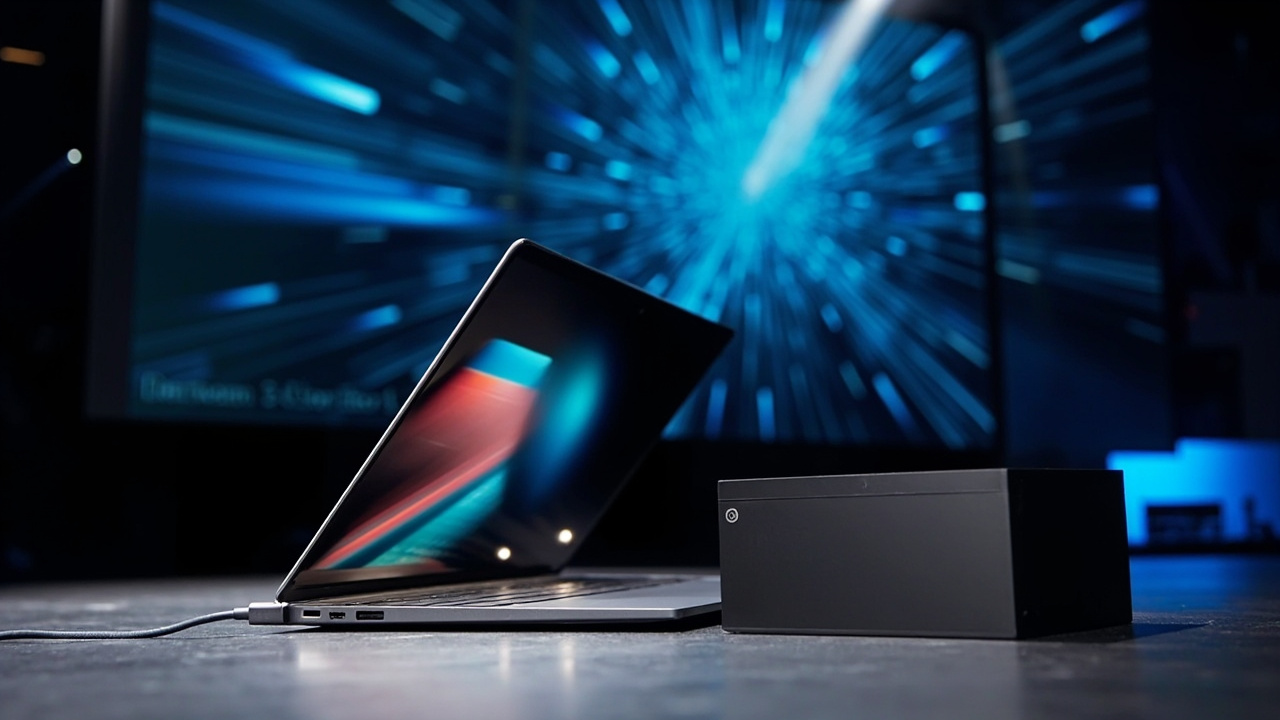
Microsoft’s Surface Laptop Ultra Event: Prices, Specs and Windows AI in One Place
TL;DR: Microsoft unveiled the $2,599 Surface Laptop Ultra and $5,999 Surface RTX Spark Dev Box on October 7 in San Francisco, both built on Nvidia RTX Spark and available for preorder ahead of an October 16 release for the laptop.
Microsoft closed a Windows and Surface keynote in San Francisco on October 7, 2026 with preorder details for two builder-class systems and a set of Windows 11 agent features, according to The Verge. The company positioned the Surface Laptop Ultra as its most powerful Surface Laptop ever, built around Nvidia’s RTX Spark Superchip, while the Surface RTX Spark Dev Box brings the same platform to a desk-side mini PC, according to the Microsoft Devices Blog. Microsoft CEO Satya Nadella, Nvidia CEO Jensen Huang and Windows and Devices head Pavan Davuluri took turns on stage, according to Tom’s Hardware. “We’ve reinvented the personal computer completely,” Huang said, according to Tom’s Hardware.
San Francisco keynote centered on RTX Spark and hybrid intelligence
The event paired hardware built on RTX Spark with Windows work described as hybrid intelligence, combining PC and cloud power for AI tasks, according to the Microsoft Devices Blog. Nadella described work around a frontier ecosystem anchored in Agent 365, Microsoft IQ and Copilot, according to Tom’s Hardware. Davuluri described Windows 11 as the most secure platform for AI agents and highlighted containment for agents, according to Tom’s Hardware.
Devices from Asus, Dell, Lenovo, HP and MSI using the broader Spark ecosystem were also discussed alongside Microsoft’s own systems, according to Tom’s Hardware. Davuluri also announced DGX Spark and Station for Windows, described as a supercomputer to bring last quarter’s frontier to the desktop, with desktops from HP and Dell to come later this year after being exclusive for Linux up to this point, according to Tom’s Hardware.
Surface Laptop Ultra price, preorder and release date
The Surface Laptop Ultra will start at $2,599 for a configuration with an 8-core CPU, 24GB of RAM and 512GB of storage, and it will be released on October 16, according to The Verge. Both the laptop and the Surface RTX Spark Dev Box were described as available for preorder, with PCs from Asus, Dell, Lenovo, HP and MSI to ship next Friday, Oct. 16, according to Tom’s Hardware. Microsoft also announced that the Surface RTX Spark Dev Box is available for preorder for $5,999 ahead of shipping in November, according to The Verge.
The laptop is aimed at developers and AI researchers rather than typical PC buyers, described by Microsoft as a builder-class PC, according to Engadget. Microsoft said earlier this year that the machine was the most powerful thing it had ever made, while noting its Mini-LED display and Nvidia RTX Spark chip before the October disclosure, according to Engadget.
One superchip: Blackwell GPU, Grace CPU and unified memory
Surface Laptop Ultra unites an Nvidia Blackwell RTX GPU with up to 6,144 cores, an Nvidia Grace CPU with up to 20 cores and up to 128GB of unified memory, according to the Microsoft Devices Blog. The system is rated for up to 1 petaflop of AI performance and can run AI models exceeding 120B parameters locally, according to the Microsoft Devices Blog. It can keep more work on-device with less reliance on the cloud and with access to the CUDA ecosystem and full Windows AI stack, according to the Microsoft Devices Blog.
More specifically, the Surface Laptop Ultra will be available in two main configurations: one with an RTX Spark N1X chip with an 18-core CPU or a more powerful version featuring a 20-core CPU, according to Engadget. RAM tops out at 32GB for the base model but can go up to 128GB when paired with a 20-core RTX Spark processor, according to Engadget. On Microsoft’s product page, SSD size tops out at 2TB, but storage is user-upgradable for later expansion, according to Engadget.
Chassis, display, ports and Magnetic Connect
Microsoft designed a new thermal architecture that delivers up to 2.5x more thermal power capacity than current Surface Laptops, in a chassis less than 18 mm thin and under 4.5 lb, according to the Microsoft Devices Blog. Engadget reported the same platform as capable of pushing up to one petaflop of FP4 AI compute, with 2.5 times more thermal capacity than any previous Microsoft notebook, and said Microsoft claims the system delivers 99 percent of its max performance even when not plugged into the wall.
The 15-inch PixelSense Ultra touchscreen is described as the brightest, sharpest and most vivid display ever put on a Surface Laptop, according to the Microsoft Devices Blog. It comes standard with a 15-inch Mini-LED PixelSense Ultra touchscreen with a 3:2 aspect ratio and up to 2,000 nits of peak brightness, according to Engadget. Microsoft claims the brightest peak HDR of any laptop, up to 25% brighter peak HDR than MacBook Pro M5, according to the Microsoft Devices Blog.
The touchpad is 30% larger with advanced haptics for precise control across creative workflows, according to the Microsoft Devices Blog. Engadget described it as a huge haptic touchpad that Microsoft says is 30 percent larger than typical 15-inch Surface notebooks. Storage is user-removable so users can upgrade, replace or secure their own storage, according to the Microsoft Devices Blog.
The aluminum chassis measures 18mm thick and weighs 4.5 pounds, and the Ultra will be available in platinum and nightfall, according to Engadget. Surface Laptop Ultra is available in Platinum and Nightfall, according to the Microsoft Devices Blog.
For connectivity, Microsoft introduced Magnetic Connect, described as the world’s first built-in magnetic USB-C charging on a laptop, according to the Microsoft Devices Blog. The included charging cable attaches magnetically to the right-side USB-C port and releases easily, while the port remains fully functional for video, data and other USB-C devices, according to the Microsoft Devices Blog. Engadget described Magnetic Connect as combining magnetic charging with a traditional USB-C jack while still transmitting power, video and data.
Other ports include two additional USB-C ports, HDMI, USB-A, an SD card reader and a 3.5 mm headphone jack, according to the Microsoft Devices Blog. Engadget listed USB-C, USB-A, HDMI, 3.5mm audio and a full-size SD card reader. The system can drive up to three 4K displays and import footage without adapters, according to the Microsoft Devices Blog.
Performance claims against MacBook Pro
When compared to a MacBook Pro with an M5 Pro chip, Microsoft claims the Ultra delivers 6.2 times faster video generation, 4.3 times faster image creation and is 2.1 times faster to the first token, according to Engadget. Tom’s Hardware reported the same comparison against the M5 Pro in a MacBook Pro, promising performance up to 2.1 times faster to first token, 4.3 times faster image generation and 6.2 times faster video generation.
Microsoft showed the Surface Laptop Ultra running GitHub Copilot and playing Gears of War: E-Day at 60 frames per second, according to Tom’s Hardware. Davuluri said hundreds of AAA titles and indies will be available day one, and that Call of Duty will come to RTX Spark in 2027, according to Tom’s Hardware. The company also highlighted hundreds of games including Call of Duty, according to Tom’s Hardware.
When work ends, the same RTX Spark architecture that accelerates creative and AI workloads also powers gaming with ray tracing, DLSS and Nvidia Reflex in supported titles, together with the catalog of games on Windows on Arm, according to the Microsoft Devices Blog.
Surface RTX Spark Dev Box for desk-side AI compute
Surface Laptop Ultra is built to move, while Surface RTX Spark Dev Box gives developers, AI engineers and technical teams AI compute at their desks, according to the Microsoft Devices Blog. Also built around the Nvidia RTX Spark Superchip, the developer-first system brings local AI compute to a compact small form factor, giving developers more control over where workloads run and how resources are used, according to the Microsoft Devices Blog.
Dev Box offers up to 1 petaflop of AI performance and 128GB of unified memory, support for AI models exceeding 120B parameters with large context windows, local inference, evaluation and experimentation at interactive speeds, and the same RTX Spark platform that powers Surface Laptop Ultra, according to the Microsoft Devices Blog. Engadget noted the Surface RTX Dev Box is also available for preorder now starting at $5,999. When experimentation happens locally, teams can iterate faster, reduce cloud dependency and reserve cloud resources for workloads that truly need them, according to the Microsoft Devices Blog.
The stated goal is less time configuring environments and more time building, with the system described as ready to go out of the box, according to the Microsoft Devices Blog.
Windows 11 Search, Copilot local actions and agent controls
Microsoft shared Hybrid Intelligence features that let Copilot use files on a Windows PC to take actions and a new search experience that lets users do quick actions from the search bar, according to The Verge. On Windows 11, there will be new quick actions in the Search menu in the Task Bar, making quick changes to settings, taking screenshots or arranging windows using natural language, according to Tom’s Hardware. The Taskbar will also launch Copilot if the request calls for it, and users can jump from Search to Copilot, according to Tom’s Hardware.
Microsoft’s Jacob Andreou detailed the recent launch of the new Copilot, now getting access to local files, local models and the ability to take actions on behalf of the user, according to Tom’s Hardware. It will still use cloud models but will switch to local models when privacy is called for, according to Tom’s Hardware. In one example, Andreou gathered tax data for an accountant using a mix of local and cloud models to search for documents, rename them and zip them into a folder, while Copilot also wrote an email to the accountant to send on his behalf after approval, according to Tom’s Hardware. These features are coming over the next few months, according to Tom’s Hardware.
Davuluri focused on technical details including Microsoft Execution Containers, which is moving to general availability as sandboxes integrated with the OS to decide what data is shared with agents, according to Tom’s Hardware. Windows will also require agents to attribute their actions to themselves, with IT controls for enterprises to set agentic rules once and use them across fleets, according to Tom’s Hardware. Microsoft’s Divya Venkataramu demonstrated the system, showing access to documents even when agents did not have access, according to Tom’s Hardware.
Davuluri also described hybrid intelligence as a mix of agents running locally and in the cloud to reduce token budgets, according to Tom’s Hardware. Microsoft’s HydraFusion, which balances local and cloud agents, is coming from GitHub to Windows on October 15 for GitHub Copilot, the CLI and VS Code, and will use new models like MAI Code 1.1 Flash and Nvidia’s Nemotron, according to Tom’s Hardware. Using advanced quantization, DeepSeek V4 Flash can be used at 1.6 bits to run locally at 60GB of memory, according to Tom’s Hardware.
Windows ML will serve as the runtime to deploy models across GPU, NPU and CPU, while Llama.cpp will come to Windows ML to give developers chances to experiment with new models at launch, according to Tom’s Hardware. Davuluri also described local models running from other vendors including Hermes, OpenClaw and Perplexity, with a demo using Perplexity Computer, and stated that Meta’s Muse will come to Windows, according to Tom’s Hardware. Microsoft’s Kayla Cinnamon demonstrated hybrid intelligence on a Surface RTX Dev Box by prompting GitHub Copilot to detect unused code, packages and feature flags, with an Efficiency mode that selects a model automatically based on task complexity, where a more complex prompt used GPT-6 Luna while separate sub-agents ran locally, according to Tom’s Hardware. Developers can use local models with GitHub Copilot to bring agentic coding on device, prototype agents, review code, test larger models and keep development tools running side by side, according to the Microsoft Devices Blog.
Sources referenced
- Everything announced at Microsoft’s Surface Laptop Ultra event | The Verge (https://www.theverge.com/tech/1007147/microsoft-surface-laptop-ultra-windows-event-everything-announced)
- Pre-order our most powerful Surface devices ever | Microsoft Devices Blog (https://blogs.windows.com/devices/2026/10/07/pre-order-our-most-powerful-surface-devices-ever/)