TL;DR: SpaceX launched NASA's Crew-13 to the space station on Oct. 1, 2026.
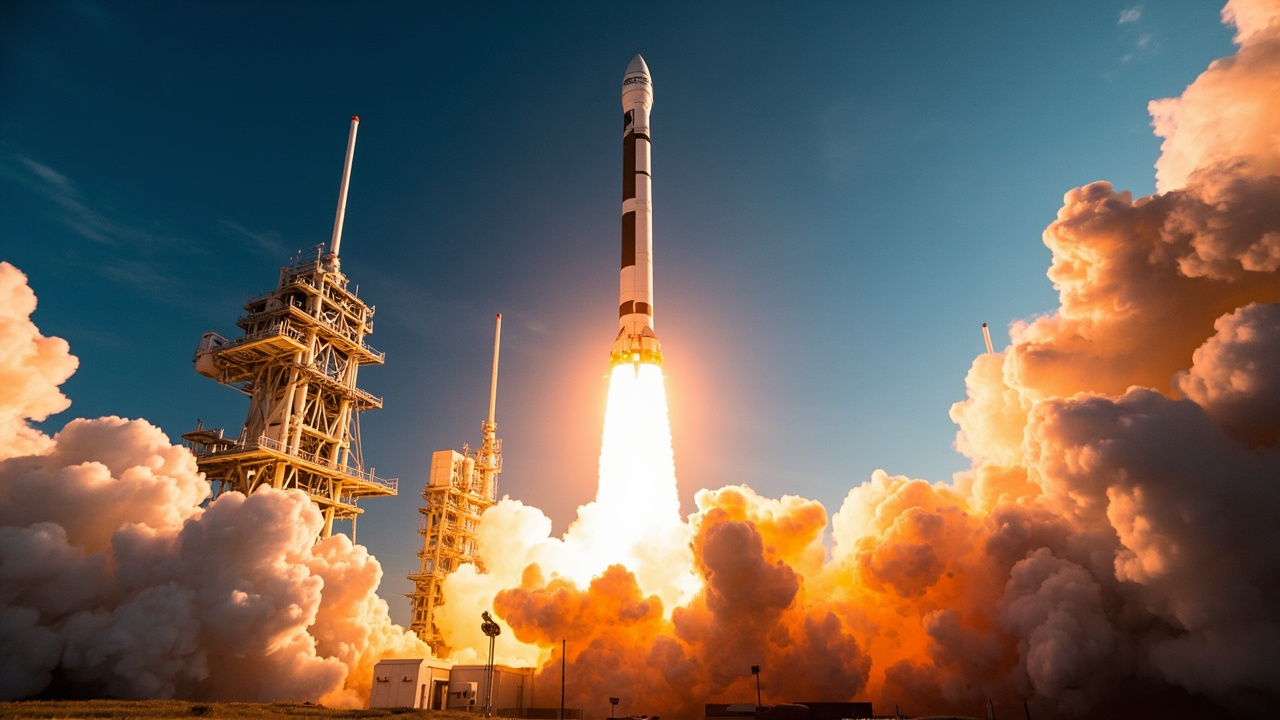
A SpaceX Falcon 9 rocket lifted off from Florida on Thursday, Oct. 1, 2026, carrying four astronauts toward the International Space Station on an eight-hour flight planned to end with docking at about 7 p.m. EDT, according to Reuters and NASA.
The mission, called Crew-13, placed NASA astronauts Jessica Watkins and Luke Delaney, Canadian Space Agency astronaut Joshua Kutryk and Roscosmos cosmonaut Sergey Teteryatnikov into orbit aboard a Crew Dragon capsule, NASA reported. The agency said the spacecraft separated from the Falcon 9 second stage and opened its nosecone after reaching orbit.
The 11:10 a.m. EDT liftoff came from Space Launch Complex 40 at Cape Canaveral Space Force Station in Florida, following a Launch Readiness Review on Sept. 30 in which NASA, SpaceX and international partner teams polled “go,” according to NASA. Live launch coverage began at 9:20 a.m. EDT.
The flight was the 13th long-duration space station team flown by NASA aboard a SpaceX vehicle since the company began sending U.S. astronauts to orbit in May 2020, Reuters reported. The company was founded in 2002 by Elon Musk, and completed a record-breaking public offering in July, according to the same reporting.
A morning liftoff from Cape Canaveral
The two-stage Falcon 9, topped with the autonomously operated Crew Dragon, launched from Florida’s Atlantic coast, Reuters reported. A live webcast showed the 25-story-tall vehicle rising on nine Merlin engines in plumes of vapor.
Under the planned profile, the reusable lower-stage booster was to separate within three minutes and fly back for a landing, while the upper stage continued carrying Dragon toward orbit, according to Reuters. The capsule was expected to reach orbit about nine minutes after launch before beginning an eight-hour cruise to the station.
NASA said Crew-13 would spend just under eight hours phasing toward the station for docking at the Harmony module. The agency described the profile as the fastest launch-to-docking in the history of the International Space Station. NASASpaceFlight.com reported the crew spent less than eight hours in free flight before autonomous docking, beating the prior Crew Dragon mark of just under 15 hours set by Crew-11.
Docking was targeted for about 7 p.m. EDT, or 2300 GMT, with the station about 250 miles, or 420 kilometers, above Earth, according to Reuters. NASA said docking coverage would begin at 5:20 p.m. on NASA+, with hatch opening about 90 minutes after docking, followed by welcoming remarks and a safety briefing.
The Expedition 75 crew prepared Harmony for the arrival, NASA reported. Station commander Jessica Meir reorganized cargo in the pressurized mating adapter where Dragon would dock, while flight engineers Anil Menon and Jack Hathaway staged supplies in Harmony for the incoming crew’s entry.
Who is flying on Crew-13
Crew-13 is commanded by NASA astronaut Jessica Watkins, 38, a geologist making her second spaceflight, according to Reuters. She became the first NASA astronaut to fly twice aboard a Crew Dragon, NASASpaceFlight.com reported.
Watkins joined NASA with the 2017 astronaut class and first flew aboard Crew Dragon Freedom on Crew-4, according to NASASpaceFlight.com. She spent 170 days in space supporting Expeditions 67 and 68. Before selection as an astronaut, she was a postdoctoral fellow at the California Institute of Technology after studies in planetary science and geology at UCLA, and served on the science team for the Curiosity Mars rover. She also became an aquanaut through the NEEMO underwater research program.
Seated beside her in the pilot role is NASA astronaut Luke Delaney, 47, a former test pilot and fighter pilot making his first spaceflight, Reuters reported. Delaney was selected as a NASA astronaut in 2021 as part of the 23rd astronaut class, according to NASASpaceFlight.com.
Delaney enlisted in the U.S. Marine Corps in 1998 as a naval aviator and saw combat in December 2001 in Afghanistan as part of Operation Enduring Freedom, according to NASASpaceFlight.com. He later flew the KC-130 and became a test pilot instructor on the T-6B, C-12C, U-6A and NU-1B aircraft. Including his NASA work, he logged more than 3,700 hours in 48 aircraft. After leaving the Marines in 2020, he joined NASA’s Langley Research Center in Virginia to support airborne science missions.
The two mission specialists are also first-time space flyers, Reuters reported. Canadian astronaut Joshua Kutryk, 44, is a former test and fighter pilot, while Russian cosmonaut Sergey Teteryatnikov, 37, is an engineer who specialized in submarine operations.
Kutryk is the first Canadian astronaut to fly as part of NASA’s Commercial Crew Program and the second Canadian to fly on a Crew Dragon after Mark Pathy’s private Axiom flight, according to NASASpaceFlight.com. He was one of two people selected for the Canadian Space Agency’s 2017 astronaut group, alongside Jenni Gibbons.
Kutryk had previously been assigned in 2023 to the first operational crew flight of Boeing’s Starliner vehicle, according to NASASpaceFlight.com. After the Crew Flight Test with Butch Wilmore and Suni Williams was later classified as a Type A mishap, Starliner-1 was changed to a cargo resupply mission. Other astronauts from that assignment later flew aboard Crew-11, while Kutryk remained unassigned until his selection for Crew-13 in April 2026.
Born in Alberta, Kutryk graduated from the Royal Military College of Canada and earned master’s degrees at Embry-Riddle Aeronautical University, Air University in the United States and the Royal Military College of Canada, according to NASASpaceFlight.com. He graduated from test pilot school at Edwards Air Force Base, flew the CF-188 with the Royal Canadian Air Force, and deployed to Afghanistan and Libya.
Teteryatnikov was selected by Roscosmos in January 2021 and graduated from Russia’s Naval Engineering Institute, according to NASASpaceFlight.com.
The Dragon capsule Grace and weeks of delay
The crew flew aboard Crew Dragon C213, named Grace, according to NASASpaceFlight.com. The capsule was making its second flight and its first long-duration stay at the station. It first flew in June 2025 as part of the Axiom-4 mission and spent just over 20 days in space.
The launch had moved from a Sept. 12 attempt after an oxidizer leak was found in Dragon’s propulsion system during standard prelaunch processing, according to NASASpaceFlight.com. The Crew Dragon uses 16 Draco thrusters for on-orbit maneuvering with hypergolic propellants that ignite on contact, identified as monomethyl hydrazine fuel and nitrogen tetroxide oxidizer.
The crew waited in Houston while the issue was resolved and arrived in Florida on Sept. 26, according to NASASpaceFlight.com. They completed a dry dress rehearsal on Sept. 29 covering launch-day activities without propellants loaded in the rocket.
NASA’s Sept. 30 readiness update listed Watkins, Delaney, Kutryk and Teteryatnikov as the crew launching aboard Falcon 9 and Dragon from Space Launch Complex 40. A prelaunch news conference included NASA’s Lori Glaze and Dana Weigel, the Canadian Space Agency’s Mathieu Caron and SpaceX’s William Gerstenmaier.
After reaching orbit on Oct. 1, NASA scheduled a postlaunch news conference at approximately 1:10 p.m. EDT at Kennedy Space Center, according to NASA. Listed participants were NASA Administrator Jared Isaacman, Lori Glaze, Dana Weigel, Mathieu Caron and SpaceX’s Julianna Scheiman, director of NASA Science and Dragon Programs. NASA said it would stream the briefing on its YouTube channel.
Eight-hour transit and science mission ahead
The four arrivals were to be welcomed by seven current occupants of the station, including the four members of Crew-12 expected to return to Earth soon after more than seven months in orbit, Reuters reported.
NASA’s station blog identified the Expedition 75 crew as NASA astronauts Jessica Meir, Jack Hathaway and Anil Menon, Roscosmos cosmonauts Anna Kikina, Andrey Fedyaev and Pyotr Dubrov, and European Space Agency astronaut Sophie Adenot. Meir, Menon and Hathaway worked on cargo and supply staging on Oct. 1 preparations, while Adenot focused on science work during that shift.
The mission is devoted to human health and performance in orbit, Reuters reported. Planned biomedical and human performance studies include research on how microgravity affects blood circulation and clotting, along with health data collection intended to inform future space missions.
The ISS National Lab said astronauts launching on Crew-13 would support a variety of sponsored research investigations, with details outlined in its Sept. 29 mission preview. NASA’s broader station updates said laboratory maintenance and research continued alongside arrival preparations.
The station spans the length of a football field and is the largest human-made object in space, Reuters reported. It has been continuously operated by a U.S.-Russian-led consortium that includes Canada, Japan and 11 European countries. The first hardware was launched more than a quarter-century ago, and NASA has said it is committed to keeping the station operating through 2030.
The launch also followed closely after SpaceX launched its next-generation Starship spacecraft on its first trip to orbit and first commercial satellite deployment, described as the vehicle’s 14th uncrewed test flight since 2023, according to Reuters.
Sources referenced
- SpaceX launches 13th long-duration astronaut crew to International Space Station | Reuters (https://www.reuters.com/business/media-telecom/spacex-launches-13th-long-duration-astronaut-crew-international-space-station-2026-10-01/)
- NASA’s SpaceX Crew-13 Reaches Orbit, News Conference at 1:10 p.m. EDT - NASA (https://www.nasa.gov/blogs/spacestation/2026/10/01/nasas-spacex-crew-13-reaches-orbit-news-conference-at-1245-p-m-edt/)