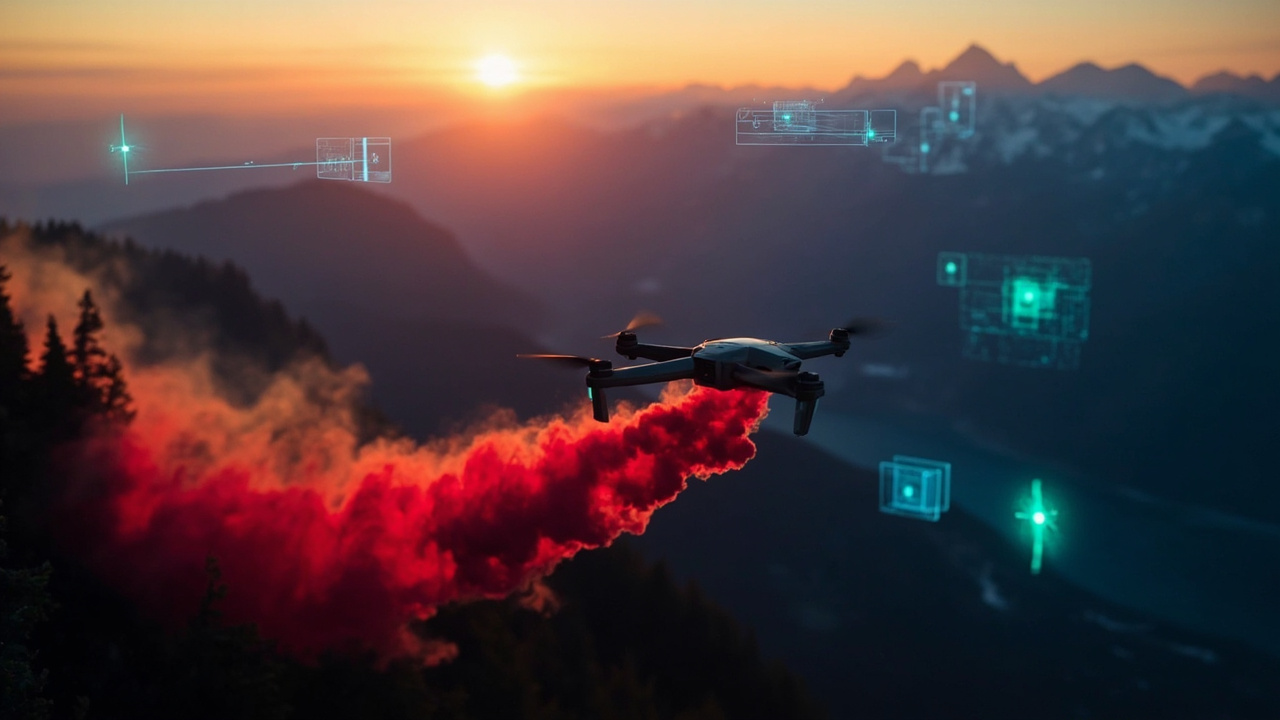
TL;DR: XPRIZE named winners in its $11 million wildfire-tech contest on September 23, 2026, after teams proved they could find fires in under 10 minutes but no team earned either grand prize for full detection or autonomous suppression.
XPRIZE announced the awardees during a ceremony at the New York City Fire Museum, closing a global contest that began in 2023 to speed up how wildfires are found and stopped at their earliest, most controllable stage, according to the XPRIZE Foundation announcement.
The result captures both progress and limits. Software that fused satellite data spotted test fires quickly, and drones linked to ground sensors reached test fires in Alaska within minutes. Yet judges concluded that reliable, complete suppression inside a strict 10-minute window remained out of reach, so the two grand prizes went unclaimed. Reporting by Ars Technica summarized the outcome as detection proving easier than stopping fires.
A $11 million contest with two 10-minute tests
The competition ran on two complementary tracks, as described in the XPRIZE Foundation announcement.
Track A, Space-Based Wildfire Detection & Intelligence, asked teams to use Earth-observation data combined with artificial intelligence and machine learning to detect, characterize and report wildfires faster and more accurately across vast landscapes.
Track B, Autonomous Wildfire Response, tested hardware in the field. In June 2026, competitors deployed systems in the Alaskan wilderness and were asked to autonomously detect and completely suppress a high-risk fire within 10 minutes of ignition across 1,000 square kilometers of difficult terrain, without disturbing nearby decoy fires.
The structure reflected a firefighter-centered goal. Andrea Santy, executive program director of XPRIZE Wildfire, said in the official announcement that teams pushed the boundaries of what is possible today while revealing where continued work is needed to move tools toward real-world use at scale. In an interview reported by Ars Technica, Santy said organizers wanted tools that help firefighters do their work more safely and protect communities and ecosystems.
Sponsors included Pacific Gas and Electric Company and the Gordon and Betty Moore Foundation as co-title sponsors, along with the Minderoo Foundation and Lockheed Martin, according to the XPRIZE Foundation announcement. PG&E is identified as the lead sponsor of the next Impact Phase.
Why 10 minutes matters
Speed was the central metric because ordinary discovery remains slow.
A 911 call is still the most typical way that wildfires are reported, and on average that takes at least 15 minutes, Santy told Ars Technica. The contest therefore aimed to demonstrate detection before any bystander call, followed by intelligence that ground crews could actually use with few false alarms.
That urgency shaped judging. Early in the Autonomous Response track, more than 300 teams entered with a wide range of concepts, including sound-based suppression, lasers, robotic dogs, ground stations and aerial systems, Santy told Ars Technica. Judges then narrowed the field toward approaches that could realistically search a large area and respond within the time and geography limits.
The space track drew 45 qualified technical submissions, according to Ars Technica.
Satellites were not built for fire — software filled the gap
Teams in Track A did not generally launch new satellites. Instead, they built AI and software to extract fire signals from existing imagery.
Current satellites are designed for other environmental and weather monitoring, not specifically for wildfire detection, Santy explained to Ars Technica. Competitors therefore worked to repurpose that broader data for fire use.
That challenge is changing. German company OroraTech launched a dedicated wildfire-detection constellation in March 2025, while the Google-backed FireSat program launched its first microsatellites in July 2026, according to Ars Technica. But during the contest finals, most capability came from algorithms, data fusion and delivery of usable alerts.
Finalists in the space track faced a real-world test at the New South Wales Rural Fire Service in Australia in April 2026, Ars Technica reported. None fully satisfied the requirements for the $3.5 million grand prize offered through Minderoo Foundation, a sponsor and co-designer of that track. Judges instead issued smaller awards totaling $1.05 million across five teams, recognizing advances in system integration, methods, commercial readiness, operations and algorithms, according to the XPRIZE Foundation announcement.
Track A winners: SIRIUS, Snuffed and three specialists
First place and $500,000 went to the United Kingdom-based SIRIUS Wildfire Alliance, honored for system integration. The alliance combined synthetic aperture radar with optical data to support fire characterization and spread modeling, according to the XPRIZE Foundation announcement. Ars Technica described the system as able to identify fires and model potential spread using both optical and radar satellite inputs.
Second place and $250,000 went to Arizona-based Team Snuffed, recognized for methodological innovation. The team built a probabilistic data-fusion framework intended to provide transparent, auditable and uncertainty-aware detection with strong usability for firefighters, according to the XPRIZE Foundation announcement.
Three special-recognition awards of $100,000 each completed Track A:
- MyRadar of Florida, cited for commercial viability, upstream satellite acquisition and spatial precision.
- DeepFire of Louisiana, cited for an operational fire-spread-alert capability.
- Mayday.AI of Germany, cited for innovative algorithm application after adapting an algorithm first developed for volcanic-ash detection to find wildfire smoke plumes through cloud cover.
Minderoo Foundation representative Andrew Forrest said the earlier test alongside the NSW Rural Fire Service showed that innovation matters only when it works where lives, livelihoods and landscapes are at risk, according to the official prize announcement carried by PR Newswire.
Alaska finals: drones found the fire, suppression fell short
The autonomy finals took place in sparsely developed rural land at Nenana, Alaska, near Fairbanks, in June 2026, according to Ars Technica. Finalists monitored a 386-square-mile zone — described as roughly the size of the San Francisco Bay Area or San Antonio — using ground sensors and in some cases surveillance drones.
Once software flagged a likely high-risk ignition, teams dispatched firefighting drones to attack it while avoiding decoys. All three finalists successfully detected the high-risk fire inside the required window, but none achieved complete autonomous suppression within 10 minutes, according to Ars Technica and the XPRIZE results.
That distinction explains why judges awarded placement prizes for progress across the response cycle rather than a grand prize for full success.
First place and $1.2 million went to Anduril Industries. Its modular Lattice software provided an integrated detection-to-suppression pathway linking cameras, sensors and drones, according to the XPRIZE Foundation announcement.
Second place and $800,000 went to Dryad Networks. Its Silvanet system, a 170-sensor persistent field network, worked with Silvaguard drones to demonstrate end-to-end autonomy, according to the XPRIZE Foundation announcement.
Third place and $500,000 went to AURA Foresight. The team demonstrated autonomous and persistent detection and met the critical 10-minute detection gate, according to the XPRIZE Foundation announcement.
Anduril also received the $1 million Lockheed Martin Accurate Detection & Intelligence Bonus Prize for rapid and precise multi-sensor detector performance, bringing its total to $2.2 million.
Adam Broecker, vice president at LM Evolve within Lockheed Martin, said watching the teams reinforced the need for a firefighter-first mindset that innovates within frontline realities, according to the announcement distributed by PR Newswire.
What judges learned about autonomy
The Alaska results highlighted a split between sensing and action.
Persistent ground networks proved valuable for continuous watch. Dryad's approach relied on many distributed sensors to catch ignition promptly, then cue drones. Anduril's strength was integration: fusing camera and sensor inputs through one software layer to guide aircraft, including Ghost-X drones shown dropping exploding fire-retardant balls in test imagery described by Ars Technica.
AURA's recognition focused on steady autonomous detection rather than suppression. Meeting the detection gate mattered because finding a small fire quickly is a prerequisite for any rapid response, even if extinguishment still requires human crews or larger aircraft.
The outcome also showed why decoys were included. A useful system must distinguish a dangerous start from other heat or smoke without sending aircraft to the wrong location, a requirement that favors uncertainty-aware software and precise geolocation.
What happens next: Impact Phase
XPRIZE said the contest will move into an Impact Phase aimed at turning promising prototypes into durable, deployable tools for wildfire management, according to the XPRIZE Foundation announcement. Planned work includes field trials, technology evaluation and sharing knowledge to speed adoption, especially in high-risk regions.
The foundation framed the awardee announcement as a milestone rather than a finish line, saying the breakthroughs were only the beginning and that collaboration among innovators and fire experts would be needed to strengthen detection accuracy and response speed.
For U.S. consumers and communities, the near-term payoff is more likely to appear as faster alerts, better maps of fire spread, and sensor networks around vulnerable areas than as fully autonomous drone firefighters. The contest demonstrated that software can shorten the interval between ignition and awareness, even while physical suppression within minutes remains the harder engineering problem.
Sources referenced
- Ars Technica - XPRIZE Wildfire winners spotted fires within 10 min—but couldn’t stop them (https://arstechnica.com/gadgets/2026/09/xprize-wildfire-winners-spotted-fires-within-10-min-but-couldnt-stop-them/)
- XPRIZE Foundation - Awardees named in XPRIZE Wildfire competition (https://www.xprize.org/news/xprize-wildfire-awardees)