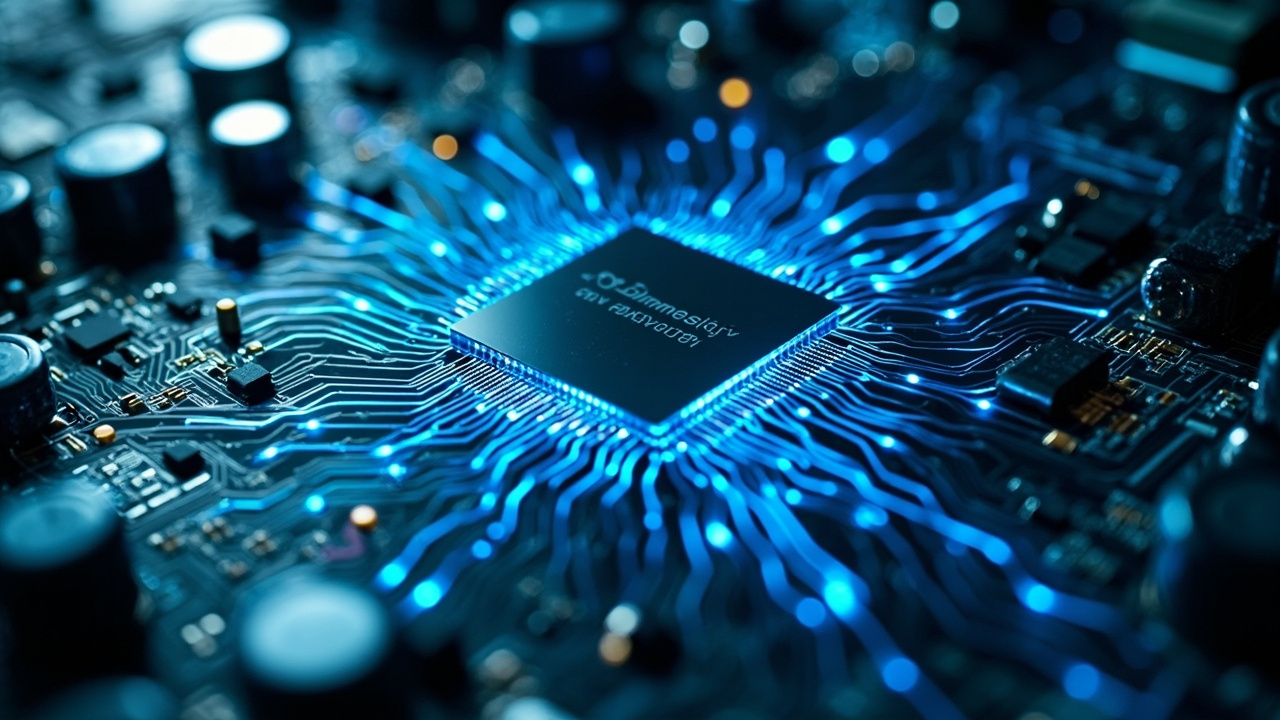
TL;DR: MediaTek announced the Dimensity 9600 Pro on Sept. 15, 2026, its first flagship smartphone chip built on a 2nm process.
MediaTek has entered the 2-nanometer era for phones. The Taiwanese chipmaker announced the Dimensity 9600 Pro on Sept. 15, 2026, in Hsinchu, Taiwan, describing it as a flagship system-on-chip that combines higher compute performance with lower power use and expanded on-device artificial intelligence, according to the company's announcement titled MediaTek Dimensity 9600 Pro Sets New Standard for Flagship Smartphone Chips.
The launch is significant because process-node shrinks are closely watched as indicators of efficiency and integration in consumer mobile hardware. MediaTek said it was the first company to announce reaching the 2nm threshold for a smartphone chip, and described itself as the world's number one provider of mobile chipsets. Independent coverage on the same day framed the part as MediaTek's first 2nm flagship chipset, with The Verge reporting in MediaTek's Dimensity 9600 Pro is its first 2nm phone chip that the processor includes a new Arm graphics unit, dual neural processors and support for high-frame-rate video.
MediaTek also introduced a second chip, the Dimensity 9600M, intended to bring flagship-level features to a wider set of phones. The company said the first smartphones powered by the Dimensity 9600 Pro and Dimensity 9600M are expected to launch this quarter.
What MediaTek announced on Sept. 15
The Sept. 15 announcement centered on the Dimensity 9600 Pro as the new top member of the Dimensity lineup. MediaTek said the chip uses what it calls a Native AI architecture and is designed for agentic AI, gaming, imaging and general compute.
JC Hsu, corporate senior vice president at MediaTek and general manager of the Wireless Communications Business Unit, said AI is central to the smartphone experience and that devices require greater performance, efficiency and intelligence. According to the MediaTek announcement, Hsu said the Dimensity 9600 Pro is intended to meet those demands through architecture and efficiency improvements for agentic AI experiences.
The announcement did not present independent test results. Performance and efficiency figures disclosed by MediaTek are company-stated comparisons with the prior generation, a distinction also reflected in same-day reporting by 9to5Google in MediaTek Dimensity 9600 Pro debuts with 2nm, performance gains and by Android Central.
CPU: 2+3+3 All Big Core layout at up to 4.55GHz
The Dimensity 9600 Pro uses a 2+3+3 All Big Core CPU design, according to MediaTek. The configuration consists of two C2-Ultra cores with clock speeds up to 4.55GHz, three C2-Pro big cores at 4.35GHz and three additional C2-Pro big cores at 3.1GHz.
MediaTek said the layout is intended to deliver faster and more responsive everyday performance while substantially reducing power consumption during multi-core work. The company reported up to 17% higher single-core performance and up to 15% higher multi-core performance compared with the previous generation, alongside a 61% reduction in multi-core power consumption.
Reporting by 9to5Google likewise described a 2+3+3 design built around Arm C2-Ultra and C2-Pro cores at the same frequencies and cited the same 17% single-core and 15% multi-core gains over last year's chip. That outlet also cited additional cache detail attributed to MediaTek, including three C2-Pro processors with 1MB L2 cache and three C2-Pro processors with 512KB L2 cache, contributing to a 21% larger L2 cache system.
Android Authority also reported an octa-core arrangement at those clock speeds and described 16MB of L3 cache plus 10MB of system-level cache. MediaTek's own announcement emphasized a larger 34.5MB total cache as part of its AI-computing foundation.
Memory, storage and scheduling
For memory and storage, MediaTek said the Dimensity 9600 Pro supports LPDDR6 memory and UFS 5.0 storage for the first time in the Dimensity platform. The company linked those interfaces to its AI Computing Fusion Architecture, which brings together CPU and NPU resources with the larger cache.
9to5Google reported that MediaTek links first-wave support for both standards to higher throughput and efficiency, quoting company material that UFS 5.0 delivers twice-faster read and write speeds than the prior generation and that LPDDR6 increases effective memory bandwidth by 33% at the same frequency.
MediaTek also pointed to an upgraded Dimensity Scheduling Engine that coordinates hardware and software to allocate computing, power and memory resources. The company said that coordination is intended to help phone makers keep multiple applications running smoothly in the background while managing power and efficiency.
Dual NPU and agentic AI claims
AI processing is a central part of the announcement. MediaTek said the Dimensity 9600 Pro uses a dual-NPU architecture and an Agentic AI Engine designed for on-device perception, reasoning and action while keeping AI experiences secure.
The company said its second-generation Super Efficient NPU reduces power consumption by 40% for always-on AI. It also said its NPU 1090 delivers 51% higher large-language-model prefill performance and 55% higher token generation per watt, with the comparisons marked by the company as measured against the prior generation.
The chip is designed to support complex on-device applications, including models with up to 30 billion parameters, according to MediaTek. The company said that capability supports features such as smart analysis of on-device data, proactive assistance and personalized responses that learn preferences and act like a digital twin.
The Verge summarized the same direction more briefly, reporting that the chip has two NPUs for additional and more efficient AI processing. Android Central similarly reported that the chipset supports AI models with up to 30 billion parameters directly on the device, allowing more complex tasks to run without continuous reliance on cloud processing.
Graphics and gaming at up to 185fps
For graphics, MediaTek said the Dimensity 9600 Pro integrates the G2-Ultra NX GPU. The company reported up to 27% higher peak performance, 24% lower power consumption at peak performance and 18% faster ray tracing.
The company positioned the result as higher console-grade gaming on-device at up to 185 frames per second. It also introduced what it calls MediaTek Dimensity Neural Graphics Architecture, which combines GPU and AI computing, while MediaTek HyperEngine is intended to further optimize gameplay for smoother high-resolution gaming.
The Verge identified the graphics block as Arm's new G2-Ultra NX GPU. 9to5Google reported the same peak-performance, power and ray-tracing figures, along with support for games at up to 185fps. Android Authority described a direct GPU-NPU synchronization approach for neural graphics rendering with improved super-resolution, alongside support for native 185fps gameplay.
Camera: Imagiq 1290 and 4K240 slow motion
Imaging is handled by the Imagiq 1290 image signal processor and a new Dimensity AI Imaging Fusion Architecture that combines ISP and NPU capabilities, according to MediaTek. The company said the combination is intended for advanced computational photography and content creation.
Specific camera-video capabilities cited by MediaTek include NPU-powered 60fps motion capture and 4K240 native direct-output ultra-slow-motion video. The company also listed 4K60 AI True Color Tone, 4K120 cinematic log and 17EV imaging for photos and videos across shooting scenarios.
The Verge highlighted support for 4K at 240fps slow-motion video as one of the headline features. 9to5Google similarly listed 4K240 native direct-output ultra-slow-motion video, 4K120 cinematic log and AI-powered True Color Tone alongside 60fps motion-capture features.
Dimensity 9600M and first phones
Alongside the Pro chip, MediaTek introduced the Dimensity 9600M. The company described it as an upcoming chipset intended to make flagship-level performance and power efficiency accessible to more users.
According to MediaTek, the 9600M uses the latest Agentic AI Engine and Dimensity Scheduling Engine for intelligent, responsive and power-efficient operation. The company said its NPU supports advanced on-device AI, including always-on perception and real-time AI-enhanced imaging, while its ISP supports professional-quality imaging and real-time tracking. For gaming, MediaTek said HyperEngine enables smooth gameplay at up to 185fps, supported by connectivity technologies for mobile use.
MediaTek did not publish full separate specifications for the 9600M in its Pro announcement beyond that positioning. 9to5Google reported that MediaTek is also announcing the Dimensity 9600M as a lower-cost version with flagship-level performance, adding that it lacks UFS 5.0 and uses Arm C1 cores instead of C2 cores.
Phone adoption was already beginning to come into focus on announcement day. The Verge reported that Oppo had said its Find X10 Pro Max will use the 9600 Pro, as will Vivo's X500 Pro. 9to5Google reported that one of the first devices powered by the chip will be Oppo's Find X10 Pro Max, due to be announced next week. MediaTek itself said only that the first smartphones using the Dimensity 9600 Pro and Dimensity 9600M are expected this quarter, so the specific model timing remains attributed to those device makers and early coverage rather than a completed phone launch.
Competitive context for the 2nm transition
The announcement places MediaTek among the early suppliers describing 2nm smartphone silicon. Android Authority reported that the Dimensity 9600 Pro is the third major 2nm mobile chipset, following the Samsung Exynos 2600 earlier this year and the recently announced Apple A20 Pro. Android Central reported that Apple's 2nm A20 Pro had already launched inside the iPhone 18 Pro series, while Qualcomm was expected to reveal its competing flagship silicon at its Snapdragon Summit later in September.
Those comparisons concern announcement and product timing, not head-to-head performance. No independent benchmark results were included in the Sept. 15 materials reviewed, and MediaTek's figures are presented as generational improvements rather than verified third-party measurements.
For U.S. consumers, the practical effect will depend on which phones adopt the chips, carrier availability, pricing and independent testing after release. As announced, the Dimensity 9600 Pro is a completed chipset introduction; the phones, real-world battery results, sustained gaming performance and carrier-network behavior are future events that had not occurred as of the Sept. 15 announcement.