TL;DR: On Oct. 12, 2026, Galacto Corporation announced that founder Daniel Joseph Mueller is pursuing cross-disciplinary technology work in Oklahoma City spanning AI, robotics governance, biotechnology and experimental physics.
The core news is an announcement, not a peer-reviewed result. According to the AP News release titled “Technologist and Author Daniel J. Mueller is Advancing Research Across AI, Engineering, and Experimental Physics,” Mueller is developing technologies that link machine intelligence, computational systems, robotics, biotechnology and experimental physics under one independent research program.
A second company announcement, the Markets Insider announcement titled “Daniel J. Mueller: Technology, Causality, and the Future of Intelligent Systems,” presents overlapping biographical and technical detail with a different emphasis on causality, measurement and information representation. Together the two Oct. 12, 2026 issuances define the public record for this story: who Mueller is, what filings and manuscripts are attributed to him, and which projects are described as ongoing or planned.
This archive report describes plans as plans and separates what the announcements document from what they do not establish.
Who announced what on Oct. 12
The Oct. 12 Galacto Corporation issuance identifies Daniel Joseph Mueller as an American technologist, inventor and researcher based in Oklahoma City, Oklahoma, and as founder of Galacto Corporation, according to the AP News release.
That release frames his program as an effort to unite fields that are usually managed separately, with stated attention to computational transparency, technical autonomy and study of basic physical systems.
The Markets Insider announcement, issued through Untitled-7 LLC and attributed to contact Daniel Mueller, describes Mueller as an independent technologist and researcher examining connections among information, computation, physical systems and human society.
Both announcements locate the work at Galacto Corporation in Oklahoma City and point to danieljosephmueller.com as the documentation site for research and professional activity. The Markets Insider announcement also lists galacto-corp.com as the company site and [email protected] for media and professional inquiries.
Neither issuance reports a new product launch with pricing, availability or customer shipment. Neither reports a journal publication, conference presentation or outside replication. The news event is therefore best understood as a completed company announcement about continuing and planned research.
A cross-disciplinary program in one lab
Rather than focusing on one specialty, Mueller’s portfolio as described moves among theory, code and bench hardware, according to the AP News release.
The release says projects join software, electronics, computation and experimental measurement. Work is said to cover artificial intelligence, scientific computing, software and hardware engineering, biotechnology and experimental physics.
The Markets Insider announcement uses similar language, listing artificial intelligence, software development, experimental physics, robotics, biotechnology, scientific research and information systems.
A recurring theme is information itself: how it is encoded, how it travels through computing and physical setups, and how its value can be kept when it is reduced or transformed, according to the Markets Insider announcement. Another theme is governance of intelligent behavior, alongside efforts to turn broad scientific questions into measurable tests.
The AP News release adds a methodological point, saying Mueller favors systems whose operation can be inspected, measured and checked by others, and distinguishes between producing a computational output and grasping the process that generated it.
Two patent filings anchor the computing claims
The most concrete public records named in both announcements are two U.S. patent applications on which Mueller is listed alone as inventor.
The filings are identified as US 2025/0299779 A1 and US 2026/0220089 A1, according to the Markets Insider announcement.
US 2025/0299779 A1 concerns bacterial classification with deep learning applied to biological sequence data, according to the Markets Insider announcement. The AP News release describes the same filing as deep-learning bacterial classification for identifying and distinguishing bacterial organisms, joining machine learning with microbiology.
US 2026/0220089 A1 concerns semantic data compression, or reducing information while keeping meaning needed for interpretation or later computation, according to the Markets Insider announcement. That announcement contrasts this direction with conventional compression centered on file size, reconstruction fidelity and processing cost, saying semantic compression weighs informational value and its retention in a more compact form.
The AP News release describes the second filing in parallel terms as semantically preserved data compression that trims digital information while retaining characteristics needed for later interpretation or processing.
Presented together, the pair illustrate two strands: machine interpretation of biological information and more efficient representation of digital information, according to the AP News release. The Markets Insider announcement likewise says the two filings show interest in representing, analyzing and processing complex information across computing and biological settings.
The announcements call these patent applications, not granted patents. No grant date, claim scope ruling or licensing deal is stated in the source texts available by the archive cutoff.
A robotics manuscript still headed for print
A major written project is The Laws of Robotics of the 21st Century, described as a manuscript on responsibilities and limits for modern autonomous systems, according to the Markets Insider announcement.
The work builds on Isaac Asimov’s Three Laws while addressing present-day concerns including artificial intelligence, automated decision-making, machine autonomy, accountability, transparency, safety and human oversight, according to the same announcement. It is characterized as short-novel length with many thousands of entries.
Publication status matters for readers. The Markets Insider announcement says the manuscript is undergoing further editing ahead of publication. The AP News release similarly says the study is undergoing further editorial development ahead of a planned print edition.
In other words, the book is announced as forthcoming, not released. The AP News release treats it as a systematic treatment of robotics governance aimed at real-world use rather than literary exploration, considering links among autonomous decision-making, machine behavior, human authority and duties tied to more capable AI.
No publisher, publication date, page count or table of contents is given in the texts available by Oct. 12, 2026. No excerpt or outside review is cited.
Experiments on causality, signals and randomness
The most unusual strand is experimental physics around causality and retrocausality.
The AP News release describes retrocausality as the theoretical possibility that cause-and-effect connections might not always follow familiar ideas about time order. It says Mueller’s investigations look at information linked to future physical events as picked up in present measurements.
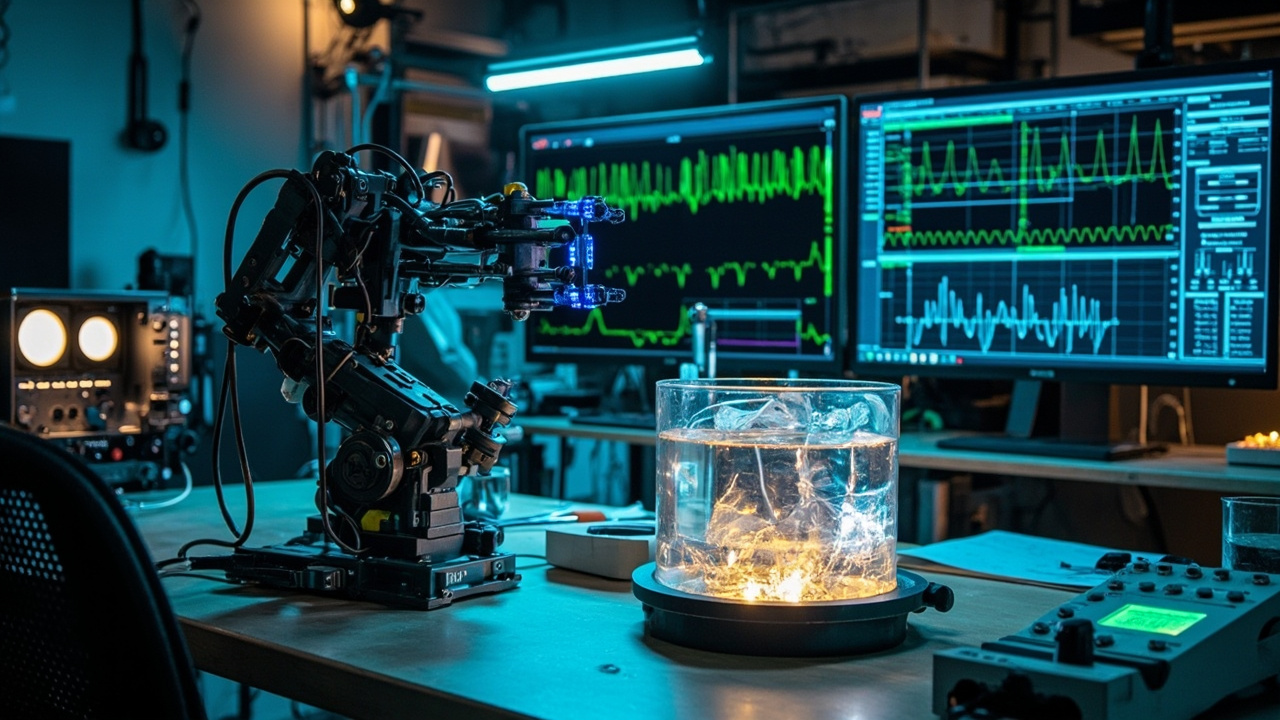
The Markets Insider announcement gives the laboratory picture: study of causality, measurement, randomness, electromagnetic interactions and signal propagation, using controlled instruments and physical tests to probe relations among events, information and time. Named elements include isolation of measurements, study of quantum randomness and timing of signals.
Both announcements say the effort includes building test apparatus, electronic instrumentation and computational methods to examine links among information, physical measurement and causality, according to the AP News release and the Markets Insider announcement. The broader interests named are foundational physics, including quantum phenomena, signals and physical limits of information-theoretic systems.
The announcements do not report a measured result, effect size, dataset or independent replication. They describe an investigative direction and custom instrumentation, not a confirmed finding about time or signaling.
Software, instruments and bioreactors
Software forms the practical base, according to the Markets Insider announcement, which says Mueller constructs computing systems for artificial intelligence, scientific research, data analysis, information processing, embedded systems and automation.
The AP News release places that software in a wider engineering practice that includes physical prototyping of consumer products and tools, plus advanced research hardware including bioreactor systems and downstream processing. It links that hardware to controlled biological environments, materials characterization, precision measurement and experimental setups.
The Markets Insider announcement similarly lists scientific instrumentation alongside artificial intelligence, software engineering, experimental physics, robotics and biotechnology as continuing research and development areas at Galacto Corporation.
Galacto Corporation itself is described as an Oklahoma City-based research and development enterprise founded by Mueller, with activities across artificial intelligence, software development, scientific research, experimental engineering, biotechnology and advanced information systems, according to the Markets Insider announcement.
What is confirmed and what is not
Confirmed by the Oct. 12 record: Mueller’s claimed identity and location, company role, the two application numbers, the title and pre-publication status of the robotics manuscript, and the described directions in software, instrumentation and causality research.
Not established in that record: performance of the classification or compression methods, safety or governance impact of the robotics framework, or validity of any retrocausal effect. The announcements contain no test data, no outside validation and no product release.
For a general technology reader, the practical takeaway is to treat the filings and manuscript title as verifiable public identifiers to watch, while viewing broader statements about transparency, autonomy and time as research aims stated by the company. Future journal papers, granted-patent records or a released book would be needed before those aims can be judged as results.