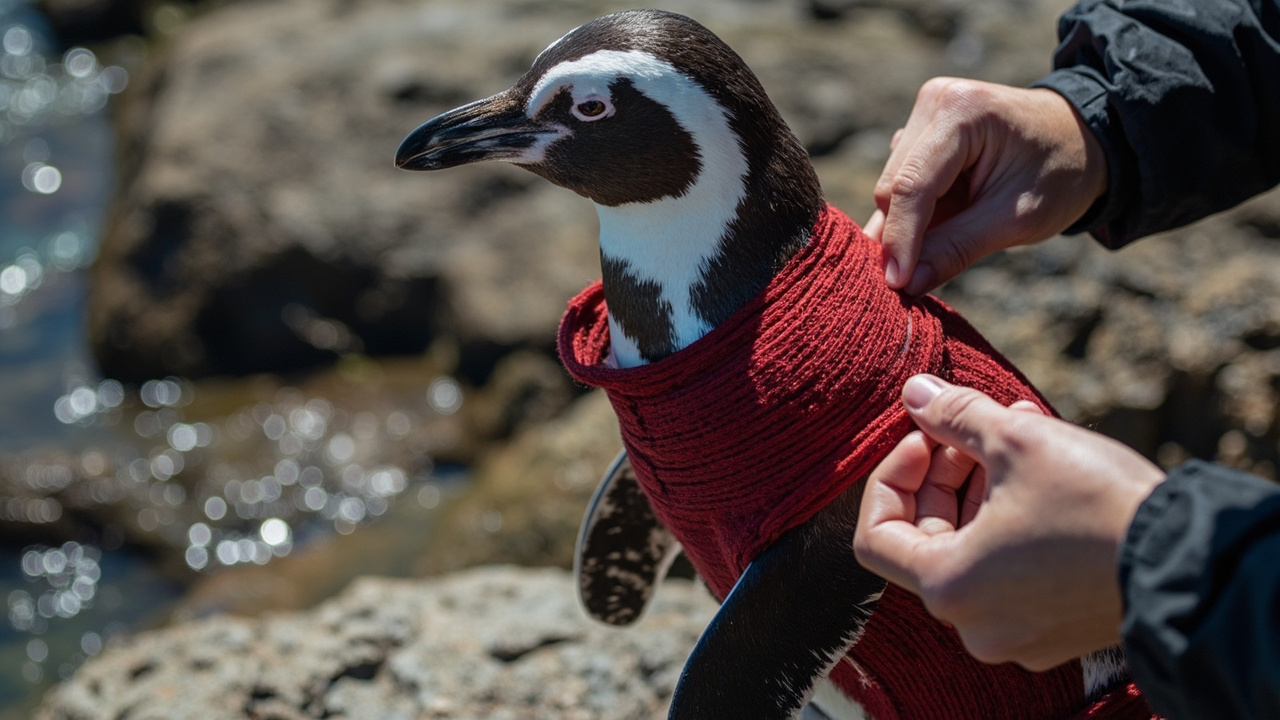
TL;DR: Chilean teams have fitted injured Humboldt and Magellanic penguins with snug red vests woven with microscopic copper and zinc to shield surgical wounds and curb microbes.
Copper-threaded vests give injured penguins a healing aid
Researchers in Chile have adapted therapeutic bodysuits once made for four-legged pets into fitted red vests for penguins recovering from surgery, according to the Associated Press. The garments place copper and zinc microfibers against skin wounds while blocking the birds from pecking at stitches.
The effort centers on Humboldt penguins, a vulnerable species with its largest concentration in Chile, according to the Associated Press. Veterinarians behind the project say the birds arrived at clinics with cuts linked to fishing nets and boat propellers, as well as weakness from scarce food.
The vests do not look metallic despite their metal content, according to Reuters. The red textile carries microscopic particles of copper and zinc inside the fibers rather than as a surface coating.
What the vest does
The vest covers the torso after cleaning and stitching of a wound. The physical barrier stops a penguin from twisting its long, flexible neck to reach a gash, according to the Associated Press. That behavior can remove stitches and reopen tissue that had begun to close.
Copper and zinc in the weave inhibit growth of bacteria and fungi, according to the Associated Press. Zinc also stimulates formation of new blood vessels, which supports faster repair of damaged tissue.
The same antimicrobial action was described by the textile developer in reporting by Reuters. Estefanía Guidotti, marketing manager for Kimba Vet, said copper and zinc help prevent growth of bacteria, fungi and mites during recovery, according to Reuters. She said zinc encourages creation of new blood vessels, helping damaged tissue heal more quickly.
Guidotti described that vascular effect as a differentiating factor versus other materials, according to Reuters. She said it allows tissues to recover faster.
Chile is the world's top producer of copper, according to the Associated Press. The project therefore puts a domestic mineral resource to work as a wound-care aid.
Who built the penguin suits
The adaptation involved Conservación Humboldt, also called the Humboldt Conservation Center, a nonprofit that rehabilitates injured marine animals in northern Chile, according to the Associated Press and Reuters. Partners included the Catholic University of the North and textile innovation company Kimba Vet, according to Reuters.
Ignacio Idalsoaga directs Buin Zoo, a wildlife park on the outskirts of Santiago, Chile's capital, according to the Associated Press. Researchers took measurements of penguins at the zoo to develop the first bodysuits.
Idalsoaga said vests with microfibers containing elements like copper and zinc had been tested for years on pets, particularly dogs and cats, and had greatly helped recovery of skin wounds, according to the Associated Press. He said the team began to ask why the approach could not be used on penguins.
Tomás Pino is a veterinarian who runs Conservación Humboldt and serves as president of the Humboldt Conservation Center, according to the Associated Press and Reuters. Pino said protecting wounds in penguins posed a challenge because the birds are wild and have very flexible necks, making it easy for them to pull out stitches or reopen healing wounds, according to Reuters.
How the first trial worked
The suits were tested on five penguins at the Humboldt Conservation Center in Coquimbo, a facility that rehabilitates Humboldt and Magellanic penguins on Chile's central rocky coast, according to Reuters. Four of the five had wounds believed to have been caused by human activity, most likely entanglement in fishing nets, according to Reuters.
That pattern matches the injuries seen more broadly in Chilean wildlife clinics. Clinics receive distressed penguins stranded along the coast, some cut by fishing nets or boat propellers and others weakened by lack of food, Pino said, according to the Associated Press.
Surgical cases often require cleaning and sutures, Pino explained, according to Chilean television reporting summarized in the Reuters account. The vest is then used to keep the repair covered during healing.
Pino said the penguins tolerated the garment quite well, according to the Associated Press. He said the team noticed wounds were in better condition from one day to the next with the vest.
The observation is preliminary rather than a controlled clinical result. The teams described improved wound appearance and tolerance, not a measured cure rate, according to the Associated Press and Reuters.
Why Humboldt penguins need help now
Chile is home to 80% of the world's remaining Humboldt penguins, according to Reuters. Scientists at the Universidad de Concepción estimate their numbers have dwindled to fewer than 20,000 from around 45,000 in the late 1990s, according to Reuters.
Chilean and international researchers surveying major breeding colonies in 2024 and 2025 found a 63% drop in active nests compared with the same sites three years earlier, according to the Associated Press. The birds face entanglement in fishing nets, plastic pollution, disease outbreaks and competition with fisheries for food, according to the Associated Press.
Humboldt penguins are classified as vulnerable on the International Union for Conservation of Nature's Red List of Threatened Species, according to Reuters. Magellanic penguins are listed as less of a concern, although populations of both are in decline, according to Reuters.
Food stress adds to injury risk. El Niño brings unusually warm waters to parts of the Pacific Ocean, making the cold-water fish that Humboldt penguins rely on harder to find, according to the Associated Press. Hunger forces penguin parents to travel farther for food and leave nests behind, according to the Associated Press.
Idalsoaga said problems caused by El Niño were likely to produce many abandoned chicks in the coming weeks, with injuries suffered in the environment, according to the Associated Press. Wildlife clinics therefore expect more young birds needing care for wounds and poor nutrition.
From pet recovery wear to seabird care
Veterinarians had found success in the past using such suits to treat injured dogs and cats, according to the Associated Press. The Chilean work extends that pet-care technology to birds by changing the cut, closures and measurements for a penguin body.
The design challenge was not only size. Dogs and cats chew at wounds with mouths at a different angle, while penguins use long necks that can bend sharply toward the chest and flank, according to the Associated Press and Reuters. The vest must stay in place on a smooth, torpedo-shaped body without limiting flipper movement or balance.
The fabrication answer was to weave microscopic metal particles into the fibers themselves, according to Reuters. That construction keeps antimicrobial material in contact with surrounding skin even as the bird moves.
The Associated Press reported the development on Sept. 2, 2026, after Idalsoaga spoke from the zoo on Wednesday. Reuters reported from Santiago on Aug. 31 that the therapeutic suit was intended to speed recovery after surgery for wounds often sustained in fishing nets.
What happens next for treated birds
The immediate goal is protection of surgical sites through the early healing phase. The vest limits self-trauma, reduces microbial growth and supports blood-vessel formation, according to the Associated Press and Reuters.
Release decisions remain with rehabilitation staff. The sources did not publish a release date for the five trial birds or a schedule for wider use. The teams presented the vests as a rehabilitation tool for stranded and injured animals, not as a solution to declining fish stocks, net entanglement or nesting losses.
For clinics along Chile's coast, the practical benefit is simpler wound management in a wild species that resists bandages. If further cases show the same tolerance and wound improvement reported by Pino, the copper-zinc vest could become standard postoperative covering for penguins with net cuts, propeller gashes and other skin injuries, according to the Associated Press and Reuters.
Sources referenced
- In Chile, injured penguins sport copper vests to help them heal - ABC News (https://abcnews.com/International/wireStory/chile-injured-penguins-sport-copper-vests-heal-136160027)
- Copper suits help injured penguins recover in Chile (https://www.msn.com/en-us/money/general/copper-suits-help-injured-penguins-recover-in-chile/ar-AA2bhQsY)