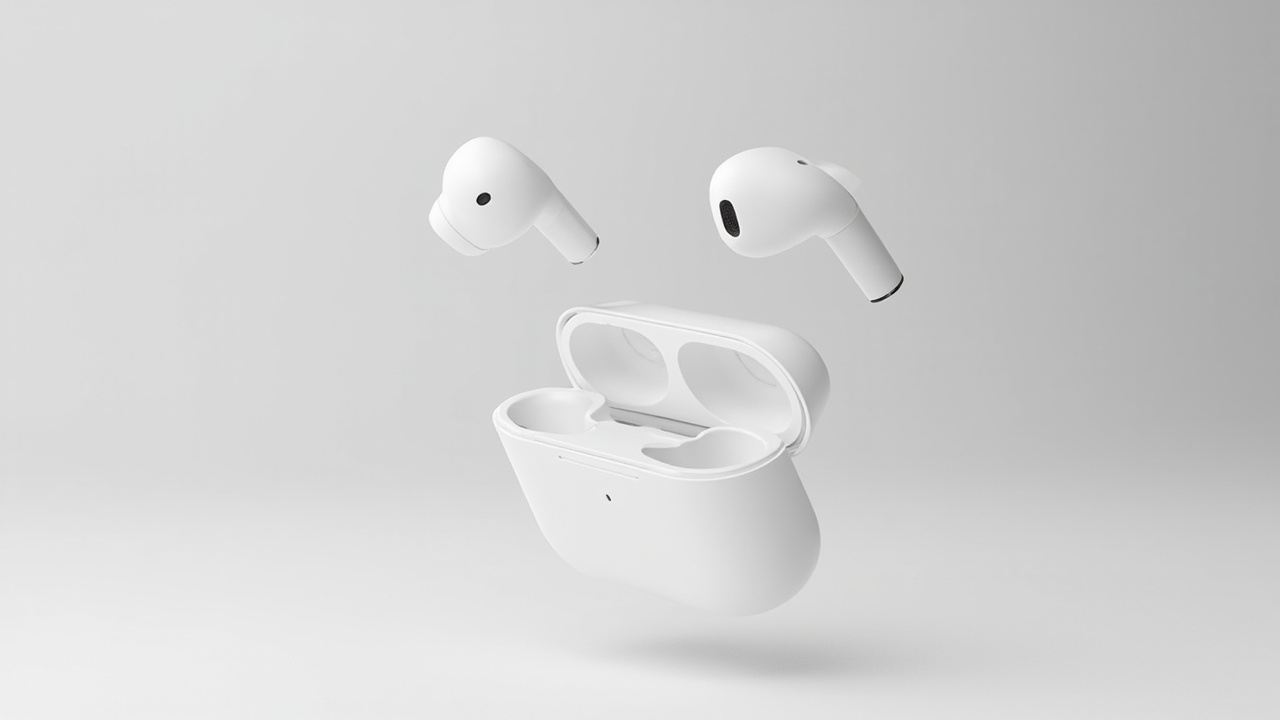
TL;DR: Apple announced AirPods 5 on September 9, 2026, making active noise cancellation standard on both $129 and $149 open-ear models, with pre-orders open that day and store availability starting Friday, September 18.
Apple used its September hardware event to update its entry-level earbuds, positioning the new AirPods 5 as the least expensive way to get several features previously tied to higher-priced configurations. According to Apple, both versions use an open-ear shape without eartips, include noise cancellation, and support hands-free Siri AI and Live Translation when paired with a compatible iPhone.
The announcement came from Cupertino, California, on September 9, 2026, alongside other new hardware and software. According to The Verge, the introduction was part of Apple's September event presentation, while Apple described the products in a same-day press release as delivering the best audio experience it had offered in this style of AirPods.
Two models replace the split ANC lineup
Apple is selling two versions of the new earbuds.
The entry model is called AirPods 5 and costs $129. The step-up model is called AirPods 5 with Wireless Charging Case and costs $149, according to Apple.
That structure changes the choice buyers faced with the prior generation. According to MacRumors, the outgoing AirPods 4 lineup charged $129 without active noise cancellation and $179 for AirPods 4 with active noise cancellation. According to Ars Technica, the older AirPods 4 debuted in 2024 with a $129 starting price, while customers paid $179 for the version with noise cancellation.
With AirPods 5, noise cancellation is no longer the feature that separates the two prices. According to MacRumors, Apple folded active noise cancellation into the $129 base model instead of reserving it for the higher-priced variant. The $20 difference now centers on charging, battery capacity, and stem volume control.
According to Apple, the $129 model offers improved dust, sweat, and water resistance and access to major listening and intelligence features at what the company called an outstanding value. For customers seeking additional hardware conveniences, Apple said the $149 version adds longer battery life and on-stem volume control.
Best-in-class open-ear noise cancellation claim
The headline technical claim is stronger noise cancellation in an open design.
Apple said AirPods 5 provide the industry's best active noise cancellation in an open-ear design. The measurable comparison offered by the company is that the new earbuds remove up to 50 percent more external noise than AirPods 4 with Active Noise Cancellation, according to Apple.
According to The Verge, Apple attributed the improvement to a redesigned acoustic architecture, upgraded adaptive noise cancellation, and improved sound. Apple said the gain comes from a new multiport acoustic architecture combined with improved computational-audio algorithms.
Open-ear earbuds do not seal the ear canal with silicone tips, making sustained noise reduction technically difficult because outside sound can enter around the earbud. Apple is therefore emphasizing both physical acoustic design and processing. According to Ars Technica, Apple credits the 50-percent improvement to the new multiport acoustic architecture and better computational-audio algorithms.
Apple also highlighted three related listening modes.
First, an improved Transparency mode is intended to represent voices and nearby sounds more naturally, helping wearers remain aware of their surroundings. Second, Adaptive Audio dynamically blends Transparency mode and noise cancellation based on environmental conditions. Third, Conversation Awareness lowers media volume when the wearer begins speaking, making it easier to talk with someone nearby without removing the earbuds, according to Apple.
According to Apple, customers commonly use noise cancellation to rest on a noisy flight, focus on music, or concentrate on work. The company presented Transparency, Adaptive Audio, and Conversation Awareness as complementary tools for moving between isolation and awareness.
Re-engineered sound and spatial audio
Beyond quieting the environment, Apple said it reworked sound reproduction.
The company said AirPods 5 use an all-new multiport acoustic architecture and next-generation Adaptive EQ for more immersive sound. According to Apple, that combination delivers richer and more detailed sound across a wider range of ear shapes.
Apple said the acoustic approach was inspired by AirPods Pro 3 and re-engineered for AirPods 5. The practical result emphasized by the company is more immersive and dynamic Personalized Spatial Audio, intended to create a stronger sense of being surrounded by music, video, or calls, according to Apple.
According to What Hi-Fi?, Apple described the outcome as richer, more detailed sound across a wider range of ear geometries. The publication also reported that the transparency mode had been revised to sound more natural.
The Verge likewise reported redesigned acoustic architecture and improved sound as central changes from the AirPods 4 series first released in 2024. That earlier series shipped in versions with and without cancellation, both using the H2 chip and pinch controls, according to The Verge.
Battery life, charging, and stem controls
Battery and controls are where the two AirPods 5 models differ most.
The premium configuration is rated for up to five hours of listening with noise cancellation turned on from one charge, which Apple described as one hour longer than AirPods 4 with noise cancellation. Combined with its charging case, total listening time with noise cancellation extends to up to 22 hours, according to reporting based on Apple's announcement materials.
According to What Hi-Fi?, the standard AirPods 5 provide four hours with noise cancellation enabled and up to 20 hours with the included standard USB-C charging case. The same outlet reported five hours with noise cancellation and 22 hours with the case for the Wireless Charging Case model.
The charging options also differ. According to Apple and Ars Technica, the wireless charging case supports Apple Watch chargers, Qi-compatible chargers, and USB-C. The standard model's case is limited to wired USB-C charging, according to What Hi-Fi?.
The $149 model also introduces stem-based volume adjustment to Apple's open-ear form factor. Apple called the force sensor with volume swipe a first for the open-ear design. Users swipe up or down on the stem to change volume quickly, according to Apple.
According to The Verge, that swipe control is the first time volume adjustment of this type has appeared on Apple's open-ear design. The publication also noted that the higher-priced model provides approximately one additional hour of playback compared with AirPods 4 with noise cancellation.
Durability was another stated improvement. Apple said both models offer greater durability through improved resistance to dust, sweat, and water. According to What Hi-Fi?, Apple identified an increased IP57 rating for handling rain, sweat, and dust ingress.
Siri AI, head gestures, and Live Translation
Apple positioned AirPods 5 as an accessory for its revised voice assistant and translation system.
For owners of an iPhone that supports Apple Intelligence, AirPods 5 provide hands-free access to Siri AI. Apple said Siri AI is rolling out in beta in iOS 27 as a more capable and conversational assistant, with understanding of personal context across messages, emails, photos, and other material, plus app actions and broad world knowledge, according to Apple.
Apple gave examples such as asking Siri to play a song recommended in a message or navigate to a dinner reservation found in an email confirmation. The company also said Siri AI offers more natural and customizable expressive voices, while Dictation captures speech with greater precision, according to Apple.
Siri Interactions allow discreet responses without speaking. According to Apple, wearers can nod to answer yes or shake their head to answer no. During the presentation, Apple hardware-engineering vice president Dave Pakula highlighted Siri AI features that work with AirPods, including Live Translation and head-gesture responses, according to Ars Technica.
Live Translation is powered by Apple Intelligence and is intended to help users communicate across languages. After configuring the feature in the Translate app and downloading desired languages, users can start it by pressing both earbud stems at once, saying the phrase for starting translation, or using the iPhone Action button, according to Apple.
The translated conversation is then heard in the user's preferred language. Apple said noise cancellation and computational audio support the feature. The company also said Live Translation is available across the entire AirPods lineup, not only AirPods 5, according to Apple.
Apps remain part of the hands-free story. Apple said Siri continues to work with third-party apps, giving examples including sending a message in WhatsApp and playing a book on Audible.
Executive context and event timing
The earbuds arrived during a leadership milestone for Apple.
According to The Verge, the announcement took place during the first major Apple event with John Ternus as chief executive. The same report noted that Ternus had been vice president of hardware engineering when the original AirPods launched in 2016.
According to reporting on the event, the earbuds appeared alongside iPhone 18 Pro hardware and iOS 27 software. Apple separately said Siri AI would arrive in beta with iOS 27.
Apple hardware-engineering vice president Dave Pakula said the company was pleased to bring one of its most popular features to its most affordable AirPods. He said both models provide a high-quality listening experience and extend functions such as Live Translation to more people, adding that pairing the earbuds with Siri AI creates expanded hands-free capability, according to Apple.
Prices, pre-orders, and September 18 availability
Both AirPods 5 configurations were available for pre-order on announcement day, September 9. Apple said store availability begins Friday, September 18, according to Apple.
The base AirPods 5 cost $129. AirPods 5 with Wireless Charging Case cost $149, which Apple said was $30 less than the previous generation's noise-cancelling model, a comparison also reflected in independent coverage of the $179 AirPods 4 with noise cancellation, according to The Verge.
The step-up model's added $20 buys the wireless-compatible case, longer rated listening time, and swipe-based volume control. Both models include noise cancellation, improved transparency, Adaptive Audio, Conversation Awareness, next-generation Adaptive EQ, Personalized Spatial Audio, improved durability, hands-free Siri AI support, head-gesture responses, and Live Translation support.
For shoppers comparing generations, the practical change is straightforward: noise cancellation no longer requires paying the higher price. Buyers choosing between the two new models instead decide whether wireless charging compatibility, extra battery capacity, and stem volume control justify the additional cost before the September 18 retail launch.
Sources referenced
- Apple introduces AirPods 5 with best-in-class open-ear Active Noise Cancellation - Apple (https://www.apple.com/newsroom/2026/09/apple-introduces-airpods-5-with-best-in-class-open-ear-active-noise-cancellation/)
- Apple announces AirPods 5 with ‘best-in-class open‑ear active noise cancellation’ | The Verge (https://www.theverge.com/tech/988479/apple-airpods-5-announcement-september-2026-event)