TL;DR: Apple introduced HomeView, a $299 smart display with Siri AI, alongside a refreshed Apple TV 4K and HomePod mini 2 at its October 13 “Welcome Home” event in New York City.
Apple holds “Welcome Home” event in New York
Apple invited press and creators to a “Welcome Home” event in New York City on October 13, 2026, according to Engadget’s event rundown titled Everything Announced At Apple's 'Welcome Home' Event. The presentation focused on the smart home, according to The Verge’s live hub titled All the news from Apple’s HomeView launch event.
The Verge reported that the October 13th program carried the tagline “Welcome Home” and centered on smart-home efforts. Engadget reported that the company used the New York gathering to reveal a batch of fresh products.
CNBC reported in Apple releases HomeView smart home hub to showcase Siri AI that the launch was the second under new CEO John Ternus, who took over from Tim Cook in September. CNBC also reported that Apple had announced new iPhone models last month, including a foldable model called Duo that retails for nearly $2,000.
HomeView is Apple’s first smart home display
The event was headlined by the debut of HomeView, Apple’s first smart home display, according to The Verge. Engadget described HomeView as Apple’s first smart home hub and its answer to Amazon’s Echo Show and Google’s Nest Hub.
Apple described the product in its own announcement titled Meet Apple HomeView, a new way to enjoy entertainment and manage the home as central to the home and personal to everyone in it. The company said HomeView brings entertainment, connection, and smart home management together in one place.
Engadget noted that reports had suggested the device would be called HomePad, but Apple instead named it HomeView. CNBC reported that HomeView will act as a voice-controlled smart home hub for Apple devices and was built to showcase new Siri AI abilities.
Two models share 7-inch display and $299 price
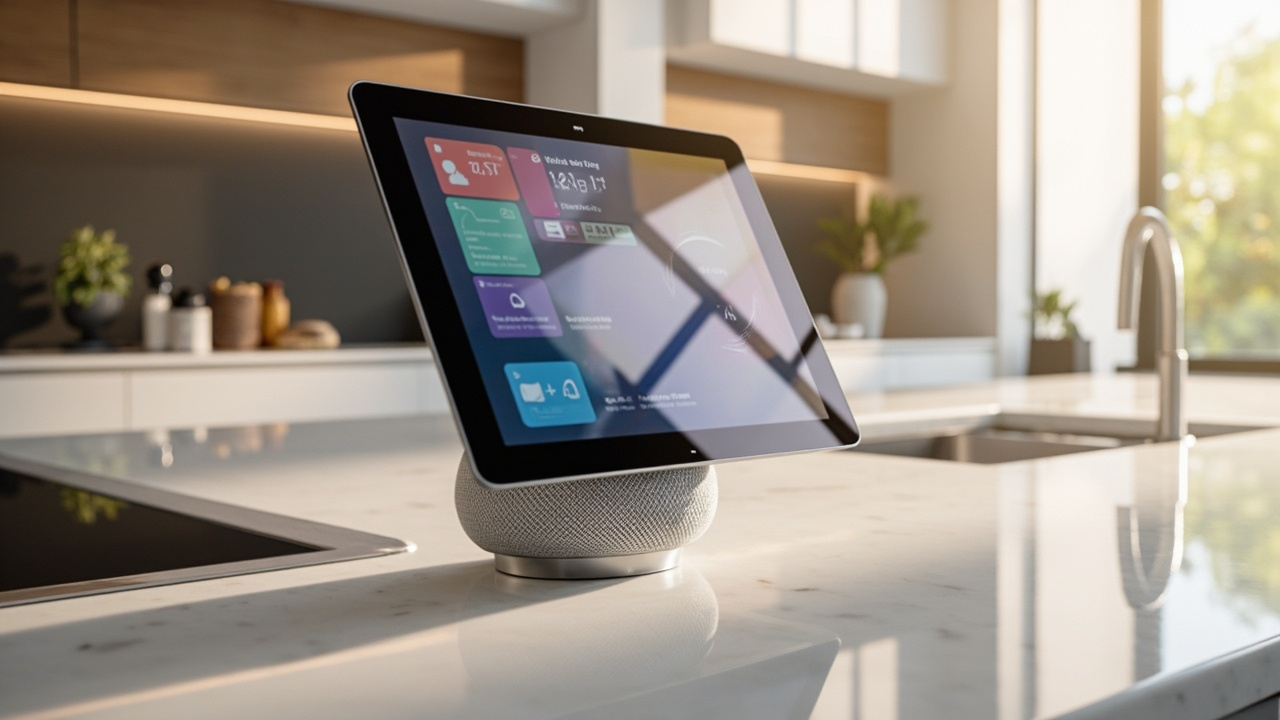
HomeView has a tilting seven-inch Liquid Retina touch display attached to a base with a speaker, according to Engadget. There are two variants, with one placed on a table or countertop and another mounted to a wall.
Apple said the tabletop design uses aluminum with a domed speaker base and a stainless steel hinge that provides smooth tilt for comfortable viewing on tabletops of any height. CNBC reported that the device with a 7-inch screen was designed to be mounted on a wall or placed on a table.
Both the tabletop and wall-mountable versions cost $299, according to Engadget and CNBC. Pre-orders opened October 13, with availability beginning November 13, according to Apple.
The countertop version comes in silver, starlight, rose pink and space gray, according to Apple. Apple said each finish includes a matching cable, and specifically listed a color-matched USB-C cable.
The separate wall-mounted model is available in space gray and silver, according to Apple. Apple said the wall version offers the same 7-inch Liquid Retina display and feature set as the tabletop model.
Screen adjusts for distance and lighting
Apple said the display uses adaptive technologies including True Tone that react to changing light throughout the day. Automatic brightness adjusts from 500 nits to 0.3 nits, according to Apple and Engadget.
Engadget reported that the 0.3-nit minimum is useful when HomeView sits on a nightstand next to a sleeping partner. Apple said 500 nits keeps the screen vivid and easy to see even in a sunlit room.
Apple said the interface adjusts based on distance, showing simpler information viewable from across the room and richer detail as a person steps closer. Engadget described a tilting seven-square-inch Liquid Retina touch display attached to a speaker base.
Audio hardware differs by model
The display includes two full-range drivers, which complement the down-firing woofer and two force-canceling passive radiators in the base of the countertop model, according to Engadget. Apple emphasized room-filling sound for music playback.
Apple said audio on the wall-mounted version is tuned for wall placement. That model does not include the domed base found on the countertop version, according to Engadget.
Apple marketing chief Greg Joswiak said the device fills the room with sound, according to Apple and CNBC. CNBC quoted Joswiak saying HomeView recognizes a face to shift from a household screen to a personal experience while supporting FaceTime, sound and smart-home control.
Face recognition supports six household members
HomeView can recognize the face of the person interacting with it for up to six people, according to Engadget. It automatically switches from a shared household screen to a customized interface for that individual.
Apple said each user receives a personalized Home Screen with apps and widgets. Personal content stays private from others, while shared photo albums and music can be enjoyed by everyone in a household, including guests.
Engadget reported that facial recognition gives a user access to their own notifications and calendar by tapping personal data from an iPhone or iPad. Apple said recognized users can access personal content in Messages, FaceTime, Calendar, Reminders and Find My.
Apple said HomeView supports custom faces in the style of Apple Watch faces, according to Engadget’s hands-on description. Engadget reported that those faces have four adjustable widgets and can feature weather details, favorite photos and Snoopy animations.
Siri AI draws on iPhone context
HomeView features Siri AI, described by Apple as an entirely new version of Siri that is more capable and conversational. Apple said Siri AI is powered by the next generation of Apple Intelligence and advanced Apple silicon.
Apple said Siri AI has broad world knowledge that supports music discovery and onscreen awareness. Engadget reported that users can start a conversation with the assistant on HomeView and continue it on another Apple device.
When paired with an Apple Intelligence-enabled iPhone or iPad, Siri AI can draw on personal context such as Calendar, Messages and relevant information across apps, according to Apple. Engadget reported that the system can tap personal data from an iPhone or iPad to provide customized responses.
Engadget also reported that users can hand off music and recipes from an iPhone to HomeView. CNBC reported that conversations with Siri will continue on an iPhone or iPad.
Camera, entertainment and photo features
HomeView supports FaceTime calls through a 12MP front-facing camera, according to Engadget. Apple said the device supports making FaceTime calls and managing home monitoring alongside music playback.
Entertainment options include music, podcasts and video streaming, according to Engadget. Apple said HomeView can follow recipes while a user cooks.
Apple said HomeView can show information from Messages, Photos, Calendar and Reminders based on who is using the device. CNBC reported that the device can be used as a digital photo frame and to make FaceTime calls.
Apple said the product runs on the A18 chipset. Engadget reported that the A18 is the same chip that powers the iPhone 16, iPhone 16 Pro, iPhone 16e and MacBook Neo.
Privacy and language availability
Apple said privacy and security are at the core of HomeView, according to its announcement. Engadget reported that Apple stressed it does not track or sell user data to others.
HomeView is initially available in English in the United States, Australia, Canada, India, New Zealand, Singapore, South Africa and the United Kingdom, according to Engadget. Apple said Canadian French support will arrive later through an update.
Apple TV 4K gets A19 chip and hands-free Siri
The refreshed Apple TV 4K runs on the A19 chipset, according to Engadget. Engadget reported that the A19 is the same chip used in the iPhone 17 and iPhone 17e.
Since Siri AI can use personal context from an iPhone, a viewer can ask for a show mentioned in a text message and the box should start playback, according to Engadget. The assistant may offer suggestions to refine searches and can display answers on screen.
The set-top box has far-field microphones for hands-free Siri AI interaction, according to Engadget. It can pair with up to four HomePod mini 2 speakers for surround sound, with automatic calibration for the room.
A misplaced updated Siri Remote can be located with a voice command that triggers an audio alert, according to Engadget. The remote also supports Find My with Precision Finding.
Pre-orders opened October 13 at $299, with shipments starting November 13, according to Engadget. CNBC also listed the new Apple TV 4K price at $299 and noted a redesigned remote that can play a sound when lost.
CNBC reported that the $299 price was an increase from $199 and followed a similar increase earlier in the year. Engadget described the new price as $100 more than the previous model even after that earlier price increase.
Apple said Siri AI is available in beta on the 2021 and 2022 Apple TV 4K models, according to Engadget. Users in the United States, Australia, Canada, India, New Zealand, Singapore, South Africa and the United Kingdom can use the assistant in English.
The fourth-generation Siri Remote will also be sold separately and works with Apple TV HD and Apple TV 4K, according to Engadget.
HomePod mini 2 adds S10 chip and new colors
Apple placed the S10 chip in HomePod mini 2 rather than an A-series processor, according to Engadget. Engadget reported that the same S10 powers Apple Watch Series 10, Series 11, SE 3 and Watch Ultra 3.
The chip enables Siri AI on the speaker, according to Engadget and The Verge. The Verge listed HomePod Mini 2 support for Siri AI among the event announcements.
CNBC reported that the HomePod Mini comes in new colors and costs $149. That price was a slight increase over the prior $129 price, according to CNBC.
Smart-home partners and one-tap setup
Apple said HomeView, Apple TV and HomePods can serve as smart-home hubs for coordinating notifications and actions, according to CNBC. CNBC reported that the hubs work with locks, doorbells and cameras from LG Electronics and Schneider Electric.
The Verge reported that Apple launched cameras, thermostats and a smart lock in partnership with other companies. Apple said wall-mounted HomeView units attach with three purpose-built mounts from Schneider Home, with self-installation or professional installation options.
HomeView can display camera feeds, adjust thermostats and lock connected doors, according to CNBC. Apple said adding a new smart-home device takes one tap from an iPhone.
Category sales and component costs
Apple TV, HomePods and HomeView fall under Apple’s Wearables, Home and Accessories category, according to CNBC. That category reported $7.88 billion in sales in the quarter ended in June, representing about 7% of total revenue, according to CNBC.
CNBC reported that the category also includes AirPods and Apple Watch. CNBC reported that investors remain focused on iPhone sales because the products announced October 13 are less critical than the iPhone.
CNBC also reported broader industry pressure from price increases and weaker demand tied to memory and storage shortages. CNBC reported that former CEO Tim Cook had said memory costs were unsustainable, while Ternus has pushed the company to release products faster.